
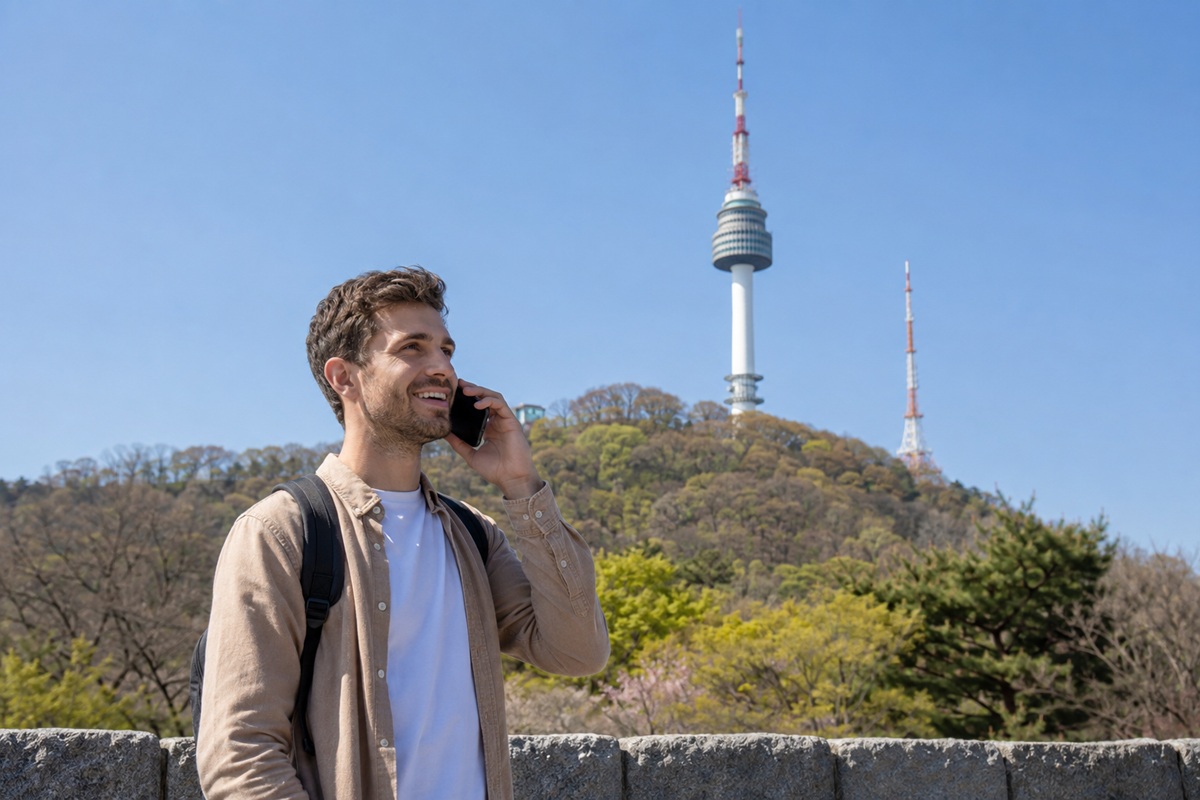
Picture this: you’ve just arrived in Seoul, opened a restaurant app, and tried to make a reservation. Everything looks easy—until the app asks for a Korean phone number. If you’re studying Korean, traveling in Korea, or planning to live there, this is one of the most practical things to understand.
A Korean phone number is more than a way to call someone. In Korea, phone numbers are often used for delivery apps, taxi apps, restaurant bookings, SMS codes, online accounts, and sometimes identity verification. The good news is that the basic format is simple once you know what 010 and +82 mean.
Let’s go through the essentials: how Korean phone numbers are written, how to say them, and how foreigners can get one.
The Basic Korean Phone Number Format
The Korean word for “phone number” is 전화번호 (jeonhwa beonho). A mobile phone number is often called 휴대폰 번호 (hyudaepon beonho) or 핸드폰 번호 (haendeupon beonho).
Most Korean mobile numbers look like this:
010-2345-6789
The first part, 010, shows that it is a mobile number. This is the number format you will see most often in everyday life.
If you write the same number in international format, it becomes:
+82-10-2345-6789
South Korea’s country code is +82. When calling Korea from overseas, the first 0 is dropped, so 010 becomes +82 10. The same rule applies to landline area codes: for example, a Seoul number starting with 02 becomes +82 2 in international format.
Mobile Numbers vs. Landline Numbers
A Korean mobile number usually starts with 010. These are the numbers used for personal phones, texting, apps, and daily communication.
Landline numbers start with area codes. For example:
| Area | Code |
|---|---|
| Seoul | 02 |
| Busan | 051 |
| Incheon | 032 |
| Daegu | 053 |
| Jeju | 064 |
As a language learner or traveler, the most important number to recognize is 010. If someone gives you a number written as 010-####-####, they are normally giving you a mobile number.
How to Say a Korean Phone Number
Korean phone numbers are usually read digit by digit using Sino-Korean numbers.
| Number | Korean | Romanization |
|---|---|---|
| 0 | 공 / 영 | gong / yeong |
| 1 | 일 | il |
| 2 | 이 | i |
| 3 | 삼 | sam |
| 4 | 사 | sa |
| 5 | 오 | o |
| 6 | 육 | yuk |
| 7 | 칠 | chil |
| 8 | 팔 | pal |
| 9 | 구 | gu |
So 010 is commonly read as:
공일공
gong-il-gong
You may also hear it read as:
영일영
yeong-il-yeong
In everyday Korean, 공일공 is very common for 010, but there is no single official required way to read a phone number.
A full number like 010-2345-6789 can be read as:
공일공 이삼사오 육칠팔구
gong-il-gong i-sam-sa-o yuk-chil-pal-gu
In real conversation, Koreans often pause between number groups. You may also hear people add 에 (e) between groups, like a soft “at” or a pause marker:
공일공에 이삼사오에 육칠팔구
gong-il-gong-e i-sam-sa-o-e yuk-chil-pal-gu
This is useful when giving your number at a phone shop, clinic, café, delivery counter, or hotel. However, simply pausing between the groups is also natural and safe.
Why Korean Phone Numbers Matter
In Korea, a phone number is often connected to everyday digital life. You may need one for:
- Restaurant reservations
- Taxi apps
- Delivery apps
- Online shopping
- Waiting lists
- Membership sign-ups
- SMS verification
- Local contact information
However, there is one important point: receiving an SMS code is not always the same as identity verification.
The Korean word 본인인증 (bonin injeung) means identity verification. Some services, especially banking or government-related services, may require a phone number registered under your legal identity in Korea. Some tourist SIMs can receive texts for simple app verification, but may not support full identity verification for banking or government services. LG U+ notes that some Voice/SMS tourist products can support SMS verification for restaurant or taxi apps, while banking or government identity verification is not supported.
So before getting a Korean number, ask yourself: do you only need data, do you need SMS, or do you need full identity verification?
How to Get a Korean Phone Number as a Traveler
For short-term visitors, the easiest option is usually a prepaid SIM card or eSIM. Korea’s major airports have roaming centers, and travelers can buy SIM cards, rent Wi-Fi devices, or use roaming services there. VISITKOREA also explains that travelers can buy prepaid SIM cards to use unlimited data or receive a personal number while traveling in Korea, often for periods from 1 to 90 days.
Travelers usually choose one of these options:
Data-only eSIM or SIM
Good for maps, translation apps, messaging apps, and browsing. Not ideal if you need a Korean phone number.
SIM or eSIM with a 010 Number
Better if you need calls, texts, restaurant bookings, taxi apps, or SMS codes.
Pocket Wi-Fi
Good for internet access, especially for groups, but it usually does not give you your own Korean phone number.
Before buying, check that your phone is unlocked and compatible with the SIM or eSIM you want to use.
How to Get a Korean Phone Number as a Long-Term Resident
If you are studying, working, or staying in Korea for a longer period, you may need a phone number connected to your legal identity.
Foreigners who plan to stay in Korea for more than 90 days generally need foreigner registration. Seoul Jung-gu Office states that foreigners intending to stay for 91 days or longer must register, and registration should be completed within 90 days of entry.
You may also hear the term Residence Card, formerly called an Alien Registration Card or ARC. Korea’s Working Holiday Info Center explains that a Residence Card is required for many activities in Korea, including opening a bank account, purchasing a mobile phone, signing a lease, and working legally.
A common path looks like this:
- Arrive in Korea and use a temporary SIM or eSIM.
- Apply for your Residence Card if you are staying long term.
- Then visit a carrier or phone shop to get a longer-term plan registered under your name.
Useful Korean Phrases at a Phone Shop
Here are simple phrases that can help:
| Korean | Romanization | Meaning |
|---|---|---|
| 전화번호가 필요해요. | Jeonhwa beonho-ga piryohaeyo. | I need a phone number. |
| 010 번호가 있어요? | Gong-il-gong beonho-ga isseoyo? | Does it have a 010 number? |
| 문자 받을 수 있어요? | Munja badeul su isseoyo? | Can I receive text messages? |
| 문자 인증 가능해요? | Munja injeung ganeunghaeyo? | Can I use it for SMS verification? |
| 본인인증 가능해요? | Bonin injeung ganeunghaeyo? | Can I use it for identity verification? |
| 여권으로 개통할 수 있어요? | Yeogwoneuro gaetonghal su isseoyo? | Can I activate it with a passport? |
| 외국인등록증이 필요해요? | Oegugin deungnokjeung-i piryohaeyo? | Do I need a Residence Card? |
Common Mistakes to Avoid
The first mistake is buying a data-only eSIM when you actually need a phone number. If you need texts or app verification, check that the plan includes SMS or a 010 number.
The second mistake is writing the international format incorrectly. Remember:
010-2345-6789 → +82-10-2345-6789
Do not write +82-010.
The third mistake is assuming every Korean number works for everything. A tourist number may work for simple calls, texts, or reservations, but not always for banking, government services, or full 본인인증.
Putting It All Together
A Korean phone number is easy to understand once you know the basics. Mobile numbers usually start with 010, and in international format, 010 becomes +82 10.
For travelers, a prepaid SIM or eSIM with a 010 number is usually enough for basic communication, reservations, and some SMS codes. For long-term residents, a Residence Card and a phone plan registered under your name may be necessary for deeper identity verification.
Start with the most useful words: 전화번호 for “phone number,” 공일공 for “010,” and 본인인증 for “identity verification.” Once you understand these, getting and using a Korean phone number becomes much less confusing—and much more useful for life in Korea.