

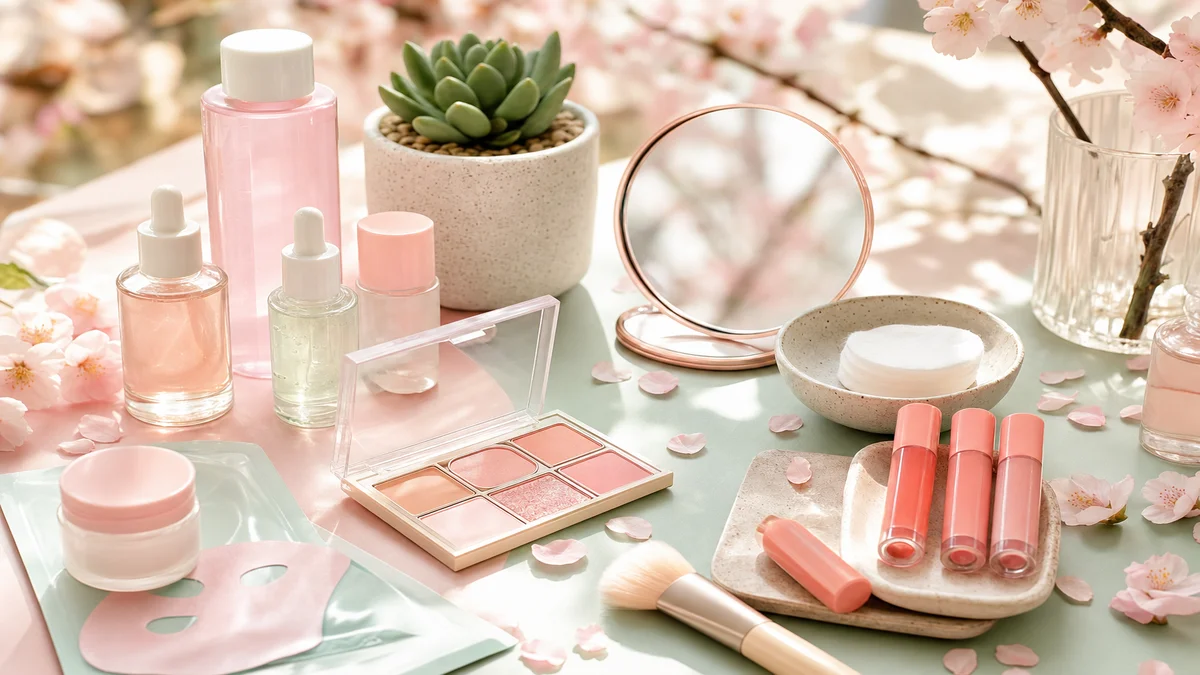
K-beauty keeps evolving, and so does the vocabulary around it. Walk into a beauty store in Seoul today and you might see everything from toner pads and cushion foundations to PDRN serums and products designed for the skin barrier.
If you’re learning Korean, beauty vocabulary is surprisingly useful. Many of these words appear on product labels, store signs, social media posts, and shopping apps.
Here are the Korean beauty words worth knowing now.
How to Say “Cosmetics” in Korean
The Korean word for cosmetics is:
화장품 (hwajangpum)
It is made from:
- 화장 (hwajang) — makeup
- 품 (pum) — goods or products
Despite the word 화장 meaning “makeup,” 화장품 can refer broadly to beauty products, including both makeup and skincare.
You may also hear:
스킨케어 (seukinkeeo) — skincare
기초 화장품 (gicho hwajangpum) — basic skincare products
색조 화장품 (saekjo hwajangpum) — color cosmetics / makeup
Everyday K-Beauty Vocabulary
These are useful words to recognize when browsing a Korean beauty store.
토너 (toneo) — toner
세럼 (sereom) — serum
앰플 (aempeul) — ampoule
크림 (keurim) — cream
마스크팩 (maseukeupaek) — sheet mask / face mask
클렌징 (keullenjing) — cleansing
선크림 (seonkeurim) — sunscreen
쿠션 (kusyeon) — cushion foundation
립 틴트 (rip tinteu) — lip tint
You’ll notice that many modern beauty terms come from English. Once you can read Hangeul, words such as 세럼, 토너, and 쿠션 become much easier to recognize.
K-Beauty Words That Are Trending Now
Current Korean beauty trends are also creating useful vocabulary for learners.
토너 패드 — Toner Pads
토너 패드 (toneo paedeu) are pre-soaked pads used as part of a skincare routine. They have become a familiar category in Korean beauty stores and are often marketed for hydration, exfoliation, or soothing.
PDRN
You may now see PDRN written directly on Korean serums, creams, masks, and toner pads. Interest in ingredient-focused skincare, including PDRN and peptides, has grown significantly in Korea as part of the broader “ingredient beauty” trend.
Because it is usually written as the English abbreviation PDRN, you do not need to learn a separate Korean word to recognize it.
피부 장벽 — Skin Barrier
피부 장벽 (pibu jangbyeok) means “skin barrier.”
- 피부 — skin
- 장벽 — barrier
Barrier-supporting and recovery-focused skincare remain prominent in current K-beauty, particularly products aimed at hydration and sensitive skin.
선스틱 and 선케어 — Sun Care
Korean sunscreen vocabulary goes well beyond 선크림.
선스틱 (seonseutik) — sun stick
선케어 (seonkeeo) — sun care
선스프레이 (seonseupeurei) — sunscreen spray
Using different sunscreen formats together—sometimes described as “sun layering”—has also appeared as a recent Korean beauty trend.
Useful Words on Korean Product Labels
You don’t need to understand every sentence on the packaging. A few keywords can tell you a lot about what a product is designed to do.
수분 (subun) — moisture / hydration
보습 (boseup) — moisturizing
진정 (jinjeong) — soothing
저자극 (jeojageuk) — low irritation / gentle
민감성 피부 (mingamseong pibu) — sensitive skin
탄력 (tallyeok) — firmness / elasticity
For example, if you see 수분 크림, you are looking at a moisturizing or hydrating cream.
Useful Korean for Beauty Shopping
Knowing product names is helpful, but a few short sentences are even more practical.
이거 추천해 주세요.
Igeo chucheonhae juseyo.
“Please recommend this kind of product to me.”
민감성 피부에 괜찮아요?
Min-gamseong pibue gwaenchanayo?
“Is this okay for sensitive skin?”
보습 잘 되는 제품 있어요?
Boseup jal doeneun jepum isseoyo?
“Do you have a product that’s very moisturizing?”
이 색 테스트해 봐도 돼요?
I saek teseuteuhae bwado dwaeyo?
“Can I test this shade?”
Learn the Words You Actually See
You don’t need to memorize dozens of beauty terms at once.
Start with 화장품, then learn the words connected to products you already use—such as 세럼, 선크림, 쿠션, or 립 틴트. After that, look for common label words like 수분, 진정, and 저자극.
The next time you browse a Korean beauty store or watch a K-beauty video, you’ll probably start spotting these words everywhere. And that is one of the easiest ways to turn everyday interests into practical Korean study.