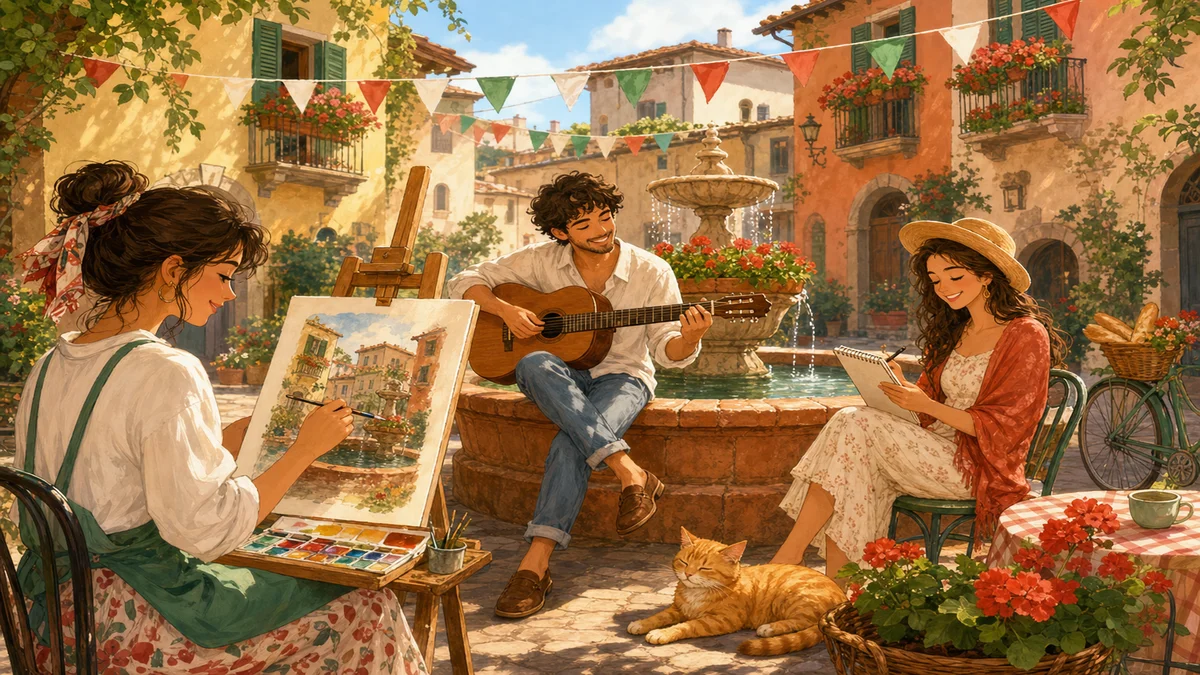
Italian is often associated with beautiful sounds, expressive gestures, great food, and some of the world’s most influential art.
For language learners, that cultural connection can be a powerful source of motivation. A film can introduce you to natural dialogue, a song can help you remember phrases, and a novel can show you how Italian sounds beyond a textbook.
If you need some inspiration, here are six Italian artists worth exploring as you learn the language.
1. Federico Fellini — Italian Through Cinema
Few directors are as closely associated with Italian cinema as Federico Fellini.
Films such as La dolce vita, 8½, and Le notti di Cabiria offer much more than famous images. They also give learners a chance to hear Italian in emotional, humorous, and dramatic situations.
Watching a Fellini film with Italian subtitles can be a useful way to connect spoken language with written words while discovering a major part of 20th-century Italian culture.
2. Lucio Battisti — Italian Through Music
If you prefer learning through music, start with Lucio Battisti.
His songs remain widely known in Italy and often focus on relationships, emotions, and everyday life. That makes them useful for noticing vocabulary that appears outside formal lessons.
Try listening once without reading the lyrics, then listen again while following the Italian words. Songs such as La canzone del sole can turn listening practice into something much easier to repeat.
3. Artemisia Gentileschi — Italian Through Art and History
Language learning does not have to begin with books or songs.
Artemisia Gentileschi, one of the most important painters of the Baroque period, offers a route into Italian art history. Her dramatic paintings often feature powerful female figures from biblical and classical stories.
Learning the Italian titles of works such as Giuditta che decapita Oloferne can also introduce useful cultural and historical vocabulary.
Art museums, exhibition descriptions, and Italian-language documentaries about Gentileschi can all become unexpected study materials.
4. Cesare Pavese — Italian Through Literature
For learners who enjoy reading, Cesare Pavese is an important name in modern Italian literature.
His novel La casa in collina is set during the Second World War and explores conflict, isolation, and moral uncertainty.
Pavese is better suited to intermediate or advanced learners than complete beginners, but you do not need to read an entire novel immediately. Starting with a page, a short passage, or a bilingual edition can help you become comfortable with literary Italian.
5. Roberto Benigni — Italian Through Humor and Emotion
Roberto Benigni is known for his energetic speaking style, comedy, and films such as La vita è bella.
His performances are particularly interesting for language learners because they show that communication is not only about vocabulary. Intonation, rhythm, facial expressions, and gestures all contribute to meaning.
Watching short interviews or film scenes can help you notice how spoken Italian changes when someone is excited, joking, or telling a story.
6. Franco Battiato — Italian Through Unusual Lyrics
Franco Battiato is a good choice for learners who want something less predictable.
His music combines pop with influences from philosophy, literature, religion, and experimental music. His lyrics can be unusual and sometimes difficult to interpret, even for native speakers.
That means Battiato may not be ideal for your first week of Italian, but his songs can be fascinating once you have built some vocabulary and want to explore the language more creatively.
How to Use Italian Art for Language Learning
You do not need to understand everything you watch, read, or hear.
Choose one artist and turn their work into a small language exercise. Watch a film scene with Italian subtitles, look up five words from a song, read a paragraph from a novel, or learn the Italian title of a painting.
The goal is not to turn every cultural experience into homework. It is to give the language a real-world context.
Final Thoughts
Italian becomes easier to stay motivated with when it is connected to something you already enjoy.
Fellini can introduce you to cinema, Battisti and Battiato to music, Pavese to literature, Gentileschi to art history, and Benigni to the rhythm and personality of spoken Italian.
Instead of learning vocabulary in isolation, use Italian culture as a reason to keep listening, reading, and discovering what comes next.