

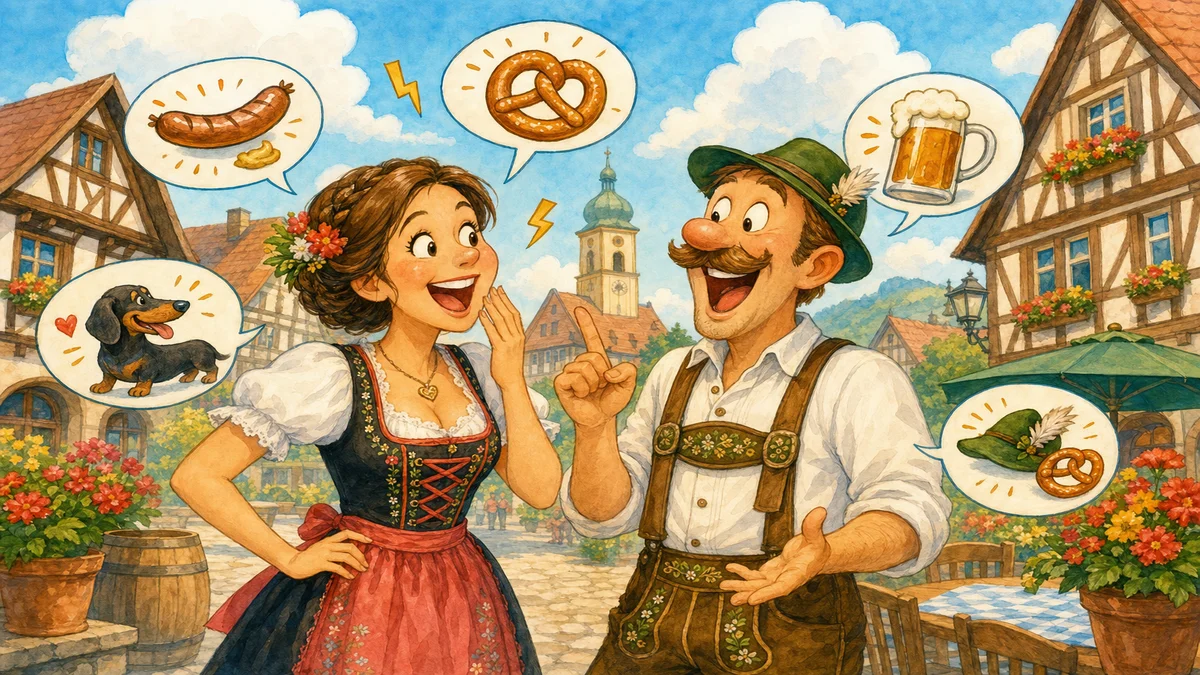
Imagine opening a German vocabulary book and discovering that there is a word that literally translates to “grief bacon.” You check it twice, thinking you must have misunderstood. But no — grief bacon really is a thing.
Welcome to German, a language famous for combining ordinary words into wonderfully specific expressions.
German is often described as logical, precise, and occasionally intimidating thanks to its impressively long compound nouns. But once you look beyond the serious reputation, you’ll find a language packed with humor, imagination, and surprisingly accurate descriptions of everyday life.
Some funny German words describe feelings and situations that would require an entire sentence in English. Others simply make you wonder how anyone came up with them in the first place.
Whether you’re taking your first steps in German or already comfortable holding a conversation, these unusual words and expressions are a fun way to expand your vocabulary — and discover a slightly different way of looking at the world.
Kopfkino — Head Cinema
You’re lying in bed trying to sleep when suddenly your brain starts producing an entire movie.
You replay something awkward you said five years ago. Then you imagine tomorrow’s meeting going terribly wrong. A few minutes later, you’re mentally planning a completely fictional argument that will probably never happen.
Welcome to Kopfkino.
The word combines Kopf (head) and Kino (cinema), literally giving us “head cinema.”
It describes vivid scenes, stories, or situations playing out inside your imagination. Kopfkino can be positive — such as daydreaming about a future holiday — or considerably less relaxing, such as imagining everything that could possibly go wrong before an important event.
It’s one of those German words that feels instantly useful once you learn it.
After all, who hasn’t occasionally bought a ticket to a completely unnecessary movie playing inside their own head?
Schnappsidee — A Boozy Brainwave
Have you ever had an idea at midnight that seemed absolutely brilliant, only to wake up the next morning and wonder why anyone agreed to it?
Perhaps you decided to start a business with three friends after a few drinks. Maybe you suddenly became convinced that taking a spontaneous four-hour train ride was the perfect way to end the evening.
That is a Schnappsidee.
The word combines Schnaps (a strong alcoholic drink) with Idee (idea), giving us something like “a schnapps idea.”
Although the word can literally suggest an idea influenced by alcohol, Germans also use it more broadly for a foolish, unrealistic, or poorly thought-out plan.
If your friend proposes driving across the country tomorrow with no hotel reservation, no map, and twenty euros between you, calling it a Schnappsidee would probably be appropriate.
Der Drahtesel — The Wire Donkey
At first, Drahtesel sounds more like a creature from a children’s story than something you’d use every day.
Draht means wire, while Esel means donkey. Put them together and you get “wire donkey” — an affectionate, slightly old-fashioned word for a bicycle.
The expression works particularly well for the sort of bicycle that has been sitting in someone’s garage for fifteen years. The brakes squeak, the basket is bent, and one of the pedals makes a mysterious clicking noise, but somehow it still gets you to the supermarket.
That’s a perfect Drahtesel.
Rather than simply calling it an old bike, the German expression gives it a little personality — almost like a stubborn but reliable animal that keeps carrying you around town.
Sie spielt die beleidigte Leberwurst — She’s Playing the Insulted Sausage
Someone didn’t invite your friend to lunch, and now she’s sitting silently in the corner, answering every question with an exaggerated “I’m fine.”
German has exactly the phrase for this situation.
Die beleidigte Leberwurst spielen literally means “to play the offended liver sausage.” It’s used when someone is sulking or behaving dramatically because they feel insulted, especially when the reason isn’t particularly serious.
Imagine someone losing a board game and spending the next half hour refusing to speak to anyone. You might jokingly tell them not to die beleidigte Leberwurst spielen.
Why a liver sausage became the symbol of exaggerated offense is less important than the fact that the image is impossible to forget.
English has expressions like “sulking” or “throwing a pity party,” but an offended sausage is considerably more entertaining.
Kummerspeck — Grief Bacon
Now for one of the most famous funny German words: Kummerspeck.
The word combines Kummer (grief, sadness, or worry) with Speck (bacon or fat). It refers to the extra weight someone gains from eating for emotional comfort.
Maybe you’ve had a stressful month, spent several evenings ordering pizza instead of cooking, and suddenly your favorite jeans feel a little tighter. That unwanted souvenir from your difficult few weeks? That’s Kummerspeck.
English usually needs expressions such as “weight gained from emotional eating” to explain the same idea. German simply puts two words together and gets straight to the point.
It’s brutally descriptive — but also strangely comforting.
Hüftgold — Hip Gold
German even has an unexpectedly glamorous expression for the extra weight that settles around your waist.
Hüftgold combines Hüfte (hip) with Gold (gold), producing the wonderfully flattering expression “hip gold.”
In practice, it refers to love handles or extra body fat around the hips and waist.
Maybe December was filled with Christmas cookies, hot chocolate, and enormous family dinners. By January, you notice your trousers aren’t quite as forgiving as they used to be.
Congratulations: you’ve acquired some Hüftgold.
Of course, the expression is usually humorous rather than genuinely complimentary. Still, calling it “gold” sounds considerably more cheerful than many English alternatives.
Sometimes vocabulary really does improve your perspective.
Jetzt geht’s um die Wurst — Now It’s About the Sausage
Sausages appear surprisingly often in German expressions, and Jetzt geht’s um die Wurst is one of the best-known examples.
Literally, the phrase means “now it’s about the sausage.”
In reality, it means something closer to “now it really matters,” “this is the moment of truth,” or “everything is on the line.”
Imagine your football team has reached a penalty shootout. Or you’ve spent months studying and you’re about to walk into the final exam.
Jetzt geht’s um die Wurst.
This is it.
The expression is traditionally associated with competitions where sausages could be given as prizes, which makes the phrase considerably more logical than it first appears.
Still, if you translate it word for word in the middle of an English conversation, you’re likely to receive a few confused looks.
Du bist das Gelbe vom Ei — You Are the Yellow of the Egg
Being called “the yellow of the egg” doesn’t immediately sound flattering.
In German, however, das Gelbe vom Ei refers to the yolk — traditionally viewed as the best or most desirable part of the egg. As a result, the expression means “the best,” “the ideal thing,” or something of particularly high quality.
Interestingly, you’re especially likely to hear it in the negative form:
Das ist nicht das Gelbe vom Ei.
Literally: “That isn’t the yellow of the egg.”
Naturally: “That’s not exactly ideal.”
For example, if your hotel room has no heating and the shower only produces cold water, you might say the situation is nicht das Gelbe vom Ei.
It’s another perfect example of an expression that initially confuses language learners but becomes surprisingly intuitive once you understand the image behind it.
Feuchtfröhlich — Wet Happy
Few adjectives summarize a lively party quite as efficiently as feuchtfröhlich.
It combines feucht (wet or moist) with fröhlich (cheerful), and it’s commonly used to describe a celebration where plenty of alcohol is being consumed and everyone is having a very good time.
For example, after attending a colleague’s birthday party that continued well past midnight, you might describe it as ein feuchtfröhlicher Abend.
Literally, that’s a “wet-happy evening.”
The phrase isn’t necessarily criticizing the people involved. Instead, it has a playful tone and suggests a cheerful gathering where drinks were flowing freely.
Why explain the entire atmosphere of the party when one adjective can do the job?
Wildpinkler — The Wild Pee-er
Some German words require almost no explanation.
A Wildpinkler is exactly what the word suggests: someone who urinates outdoors instead of finding a proper bathroom.
The related noun Wildpinkeln refers to the act itself.
You might encounter the term in newspaper stories or public campaigns, particularly in busy nightlife areas where cities are trying to discourage people from using walls, doorways, parks, or other public spaces as improvised toilets.
It’s a great example of how German can create an immediately understandable word simply by combining familiar ideas.
Even if you’ve never encountered Wildpinkler before, once you know pinkeln means “to pee,” the meaning becomes difficult to misunderstand — or forget.
Why Funny Words Are Actually Great Language Learning Tools
You may wonder whether learning expressions about bacon, sausages, bicycles, and imaginary cinemas is really useful when you’re trying to improve your German.
Surprisingly, it is — for several reasons.
- They’re easier to remember. Strange vocabulary creates strong mental images. You’re much more likely to remember “head cinema” than an ordinary list of abstract nouns.
- They offer clues about culture. Expressions such as Kopfkino, Hüftgold, and Schnappsidee show how German speakers use humor and imagery to describe everyday experiences.
- They make studying more enjoyable. Grammar exercises are useful, but they aren’t always exciting. Discovering unusual expressions adds a little entertainment to your study routine.
- They make great conversation starters. Using a phrase such as nicht das Gelbe vom Ei or recognizing Kopfkino in conversation can make interactions with native speakers much more natural and memorable.
German’s ability to create compound words is especially useful here. By joining familiar words together, the language can give names to remarkably specific feelings, behaviors, and situations.
Once you start paying attention to these combinations, you’ll begin spotting entertaining new ones everywhere.
Keep Exploring the German Language
These funny German words are only a small glimpse of what makes the language so rewarding to explore.
Behind many unusual expressions is a miniature lesson in culture, history, humor, or everyday life. And the more German you read and listen to, the more expressions you’ll discover that never seem to appear in traditional vocabulary lists.
One of the best ways to make words like these part of your active vocabulary is to encounter them naturally. Read German articles, follow German-speaking creators, watch films and television, listen to podcasts, and pay attention to the expressions native speakers actually use.
When you find an unusual word, don’t just memorize the translation. Imagine a situation where you could use it yourself. That mental connection makes vocabulary far easier to remember.
So enjoy your Kopfkino, think twice before following a Schnappsidee, and don’t worry too much about a little Hüftgold.
German may have a reputation for being serious and complicated, but spend enough time with the language and you’ll discover something else entirely:
It can also be wonderfully funny.