

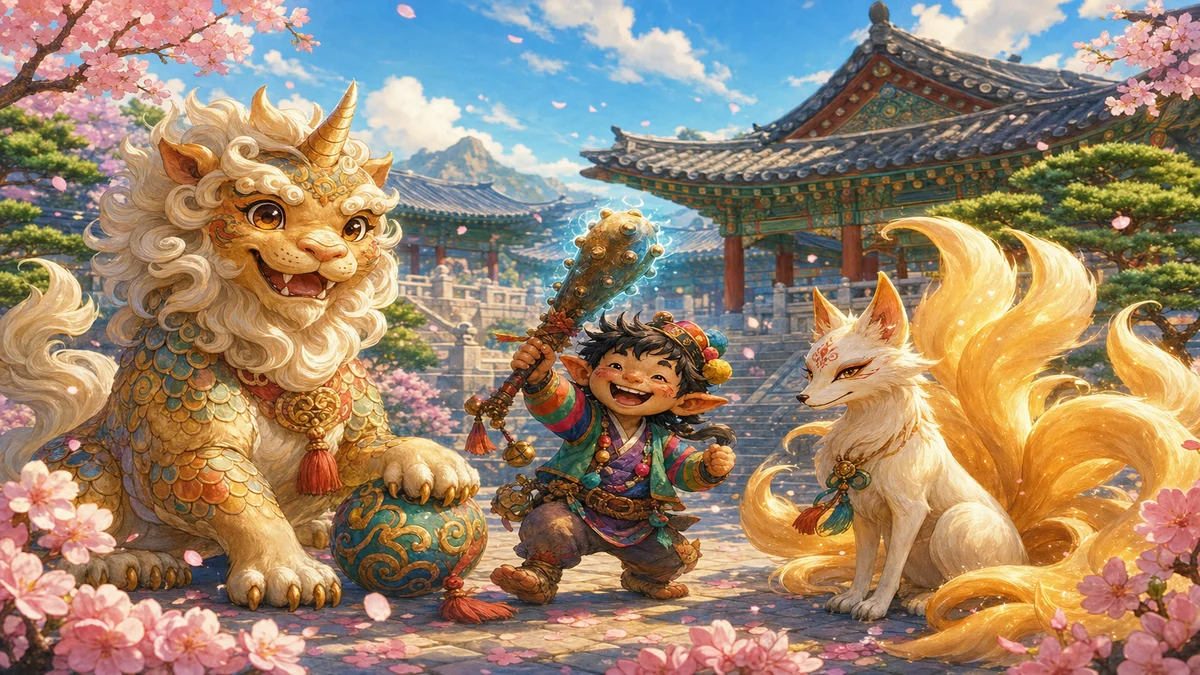
Picture this: a lone traveler walks a mountain path at dusk when a one-legged creature leaps from the shadows, demanding a wrestling match. Welcome to the world of Korean mythology — one of the richest, most imaginative collections of folklore in all of East Asia.
Korean legends have existed for thousands of years, passed down through generations long before they were ever written down. If you’ve watched Korean dramas, you may have already glimpsed some of these creatures — but the original myths are often far darker, stranger, and more fascinating than their modern retellings. Let’s take a deep dive into the legends and mythological beings that have shaped Korean culture for centuries.
What Is Korean Mythology?
Korean mythology refers to the body of folk tales, legends, and creation stories that originate from across the Korean peninsula — both what is now North Korea and South Korea. These stories are deeply woven into everyday Korean culture and identity.
What makes Korean mythology especially rich is its layered origins. It draws from Korean Shamanism (known as Muism), as well as Buddhism, Taoism, and Confucianism, all of which have influenced the peninsula at different points in history. The result is a mythology that blends spiritual belief, moral teaching, and pure imaginative storytelling in equal measure.
The earliest written records of these myths date to around the 12th century, but oral traditions carrying these stories are far older. Some tales read almost like historical accounts, while others are bursting with supernatural elements — monsters, divine beings, and magic objects. Even as Confucianism rose to become the dominant philosophy of the Joseon Dynasty, these folk legends endured and continued to evolve.
용 Yong — The Korean Dragon
Korean dragons share some visual similarities with their Chinese counterparts — long, serpentine bodies with powerful claws — but they have their own distinct character. A Korean dragon (용, yong) is distinguished by its long flowing beard and the magical orb it carries, known as the 여의주 (yeouiju). This orb is said to grant wishes and is the source of the dragon’s power.
Unlike the fire-breathing, destructive dragons of Western mythology, Korean dragons are benevolent creatures closely associated with water, rainfall, and agriculture. They were considered protectors of rivers, seas, and the people who depended on them. In fact, Korean dragons were said to be responsible for summoning the rainy season — a deeply important event for farming communities.
A related creature is the 계룡 (gyeryong), sometimes called the chicken dragon or Korean cockatrice. This beast was said to pull the chariots of legendary rulers and divine figures. One famous myth holds that a princess of the ancient Kingdom of Silla was born from a large egg laid by a gyeryong — a dramatic origin story for one of Korea’s most celebrated kingdoms.
When a dragon does not possess its orb, it is known as an 이무기 (imugi) — closer to a sea serpent — and lacks the full divine power of a true dragon.
귀신 Gwisin — Korean Ghosts
Like ghosts in many cultures, a gwisin (귀신) is the spirit of someone who has died but cannot move on to the afterlife. In Korean tradition, these spirits linger because of unfinished business — unresolved grief, a desire for revenge, or a wrongful death.
The most iconic image of a gwisin is that of a pale woman in white funeral clothing, with long black hair hanging over her face and no visible legs — she simply floats. This image has become a staple of Korean horror films and dramas, but it has deep roots in traditional belief.
One especially well-known type is the 처녀귀신 (cheonyeo gwisin), or virgin ghost — the spirit of a young woman who died before she could marry. Some historians believe this legend was used as a social warning to encourage young women to marry early, though today it is appreciated more as a haunting piece of folklore.
Another common type is the 물귀신 (mulgwisin), the water ghost. These are the spirits of people who drowned alone in rivers or lakes — such as the famous Han River in Seoul. According to legend, they drift beneath the surface, reaching up to pull the living into the water so they won’t be so lonely. It’s the kind of myth that makes you think twice before swimming alone at night.
도깨비 Dokkaebi — The Korean Goblin
If you’ve seen the wildly popular Korean drama starring actor Gong Yoo, you might picture a handsome immortal figure when you hear the word dokkaebi. The real myth, however, tells a very different story.
According to legend, a dokkaebi (도깨비) is not born — it is created. These goblins come into existence when ordinary objects, like an old club or a broom, are left discarded and become soaked in human blood over time. The object eventually transforms into a living creature.
Unlike their drama counterparts, real dokkaebi bear no resemblance to humans. Each one looks different from the next, but all are described as fearsome and awe-inspiring in equal measure. They are said to have only one leg — on their right side. Dokkaebi are known for being mischievous: they play tricks and riddles on travelers, issue challenges to wrestling matches, and sometimes carry magical objects that grant wishes or bring fortune.
Despite their frightening appearance, dokkaebi are not considered purely evil. They occupy a complex space in Korean folklore — part trickster, part supernatural force of nature.
구미호 Gumiho — The Nine-Tailed Fox
Few creatures in Korean mythology are as iconic — or as misunderstood — as the gumiho (구미호), the nine-tailed fox. Modern Korean dramas often portray the gumiho as a tragic, beautiful woman searching desperately for love and humanity. The original legend, however, is considerably more sinister.
In traditional Korean myth, the gumiho is a fox that has lived for a thousand years, gaining the ability to transform into a beautiful woman. It uses this disguise to lure unsuspecting men close — and then devours their livers. The liver (and sometimes the heart) was believed to be the seat of life force, and consuming it was how the gumiho sustained itself.
There is, however, a path to redemption. If a gumiho can resist eating human flesh for a full thousand days, it earns the right to become fully human. This element of the myth — the struggle between one’s dark nature and the desire to be good — is what has made the gumiho such a compelling figure in modern storytelling.
저승사자 Jeosung Saja — The Korean Grim Reaper
Every culture has its guide to the afterlife, and Korea is no exception. The jeosung saja (저승사자) is the messenger of the underworld, tasked with escorting the souls of the recently deceased to the realm of the dead. Think of them as a Korean equivalent of the Grim Reaper — though their role is less about causing death and more about ensuring a smooth passage afterward.
Traditionally, the jeosung saja was depicted wearing an all-black hanbok (traditional Korean attire) and a wide black hat. In more contemporary portrayals — particularly following popular dramas — they are often shown wearing long black coats and fedoras, giving them a more modern, stylish edge.
Crossing paths with a jeosung saja is considered an extremely bad omen, as it signals that death is near. They are feared not for cruelty, but for what their presence inevitably means.
해태 Haetae — The Guardian Lion
If you visit Seoul today, you’ll spot stone statues of a lion-like creature outside government buildings, palaces, and public spaces. This is the haetae (해태), sometimes written as haechi, and it is the official symbol of Seoul.
The haetae has the body of a lion, curled horn-like protrusions on its head, and a body covered in armor-like scales. In Korean mythology, it is a powerful guardian creature believed to ward off evil spirits, prevent natural disasters, and uphold justice. Because of these protective qualities, officials during the Joseon Dynasty had the haetae embroidered onto their ceremonial robes — a symbol of integrity and righteous authority.
Its presence throughout Seoul is a reminder of how deeply mythology is woven into everyday Korean life, even in a modern metropolis.
달토끼 Daltokki — The Moon Rabbit
Look closely at a full moon and you might notice shapes in the craters — in Korean tradition, those shapes form the outline of a rabbit. The daltokki (달토끼), or moon rabbit (also called the jade rabbit), is a mythological creature borrowed from Chinese and broader East Asian tradition and fully embraced in Korean culture.
The moon rabbit is said to live on the moon, endlessly pounding rice with a mortar and pestle to make tteok (rice cake). The image has become especially associated with Chuseok, Korea’s most important harvest festival, when families gather to share food and honor their ancestors under the full autumn moon.
불개 Bulgae — The Fire Dogs
Have you ever wondered what causes a solar or lunar eclipse? In Korean mythology, the answer is a pack of supernatural dogs called bulgae (불개) — fire dogs from the kingdom of darkness, known as 가망나라 (Gamangnara).
According to the legend, the king of this shadowy realm was troubled by his kingdom’s eternal darkness. He sent out his bulgae to capture the sun and moon so his people could finally have light. The fire dogs chased the celestial bodies across the sky, but every time they caught one, it proved too hot or too cold to carry back. The sun would burn them; the moon would freeze them. Each time a bulgae bit the sun or moon before letting go, an eclipse was created.
The king, undeterred, kept sending more fire dogs on the same impossible mission — which is why, in the old stories, eclipses keep happening again and again.
삼족오 Samjoko — The Three-Legged Crow
The samjoko (삼족오) is a mythical three-legged crow said to live inside the sun itself. This symbol appears in ancient Korean art and artifacts, particularly from the Goguryeo Kingdom period, and it represents the power of the sun as well as divine authority.
The three-legged crow is also found in Chinese and Japanese mythology, suggesting a shared cultural heritage across East Asia. In Korea, it was especially prominent as a royal and spiritual symbol, representing the connection between the heavens and earthly rulers.
The Founding Myth of Gojoseon — Dangun and the Bear Woman
No exploration of Korean mythology would be complete without mentioning the founding myth of Gojoseon, Korea’s first recorded kingdom. This myth tells the story of Dangun Wanggeom, the legendary founder of the Korean people.
According to the myth, the divine being Hwanung descended from heaven to live among humans on earth. A bear and a tiger both wished to become human and appealed to Hwanung for help. He gave them a challenge: stay in a cave for 100 days, eating only garlic and mugwort. The tiger quickly gave up, but the bear endured — and transformed into a woman.
This bear-woman, called Ungnyeo, eventually married Hwanung, and together they had a son named Dangun. Dangun went on to found Gojoseon in 2333 BCE, making him the mythological ancestor of all Korean people. Even today, October 3rd is celebrated in South Korea as Gaecheonjeol (개천절), or National Foundation Day, commemorating this founding myth.
Why Korean Myths Matter for Language Learners
Understanding Korean mythology isn’t just entertaining — it genuinely deepens your grasp of the Korean language and culture. Many common Korean phrases, idioms, and cultural references trace back to these ancient stories. When a Korean drama references a gumiho or a dokkaebi, you’re now equipped to understand the layers of meaning behind the reference.
Learning vocabulary connected to mythology — words like 귀신, 용, 저승사자, and 구미호 — gives you a rich, memorable context for building your Korean vocabulary. Stories stick in memory far better than vocabulary lists alone.
Korean mythology is a window into the values, fears, and dreams of Korean society across thousands of years. Whether you’re watching a fantasy drama, celebrating Chuseok, or simply walking past a haetae statue on the streets of Seoul, these ancient stories are never far away. Keep exploring, keep learning, and you’ll find that the more you understand Korea’s past, the richer your experience of modern Korean culture becomes.