

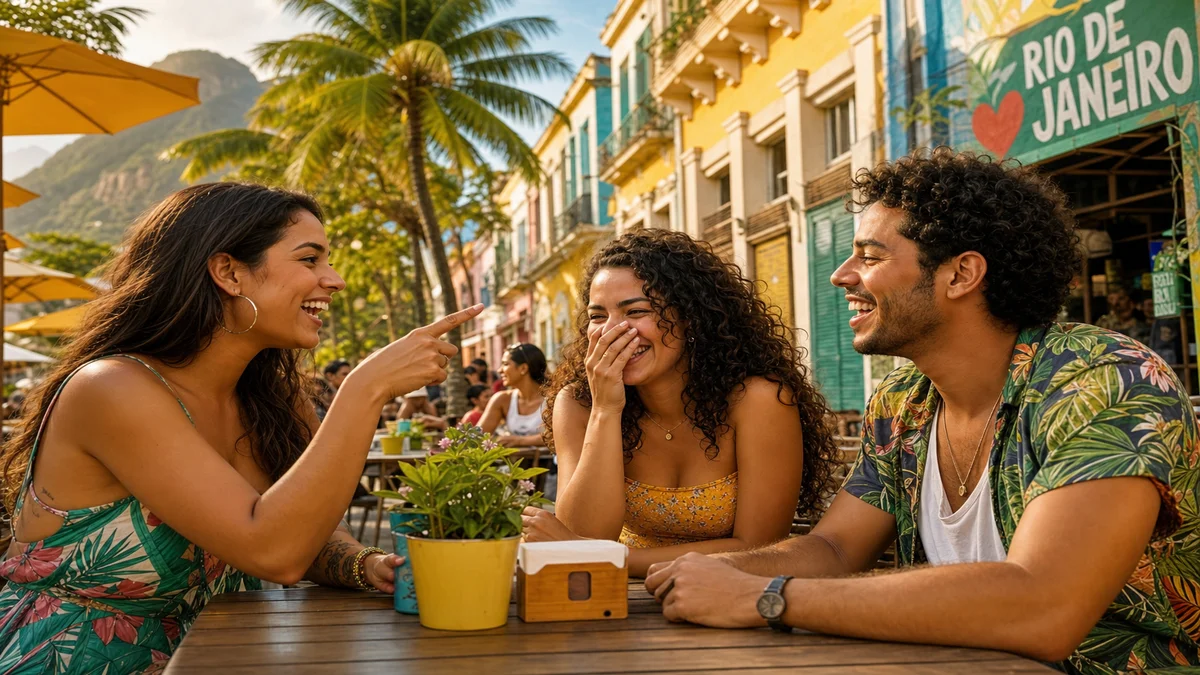
Picture this: you’ve spent months diligently studying Portuguese grammar, memorizing verb conjugations, and building your vocabulary. You feel confident enough to strike up a conversation with a Brazilian friend, only to find yourself completely lost when they start using words and phrases that sound nothing like what you learned in your textbook.
Welcome to the world of Brazilian Portuguese slang! The reality is that conversational Portuguese in Brazil is rich with colloquial expressions, cultural references, and regional slang that can leave even intermediate learners scratching their heads.
Understanding these informal expressions isn’t just about sounding cool – it’s essential for genuine communication with Brazilians. Let’s dive into ten essential Brazilian Portuguese slang words and phrases that will help bridge the gap between textbook Portuguese and real-world conversation.
Legal – The Ultimate Brazilian Seal of Approval
When Brazilians want to express approval or excitement, they often reach for the word legal (pronounced “lay-gah-oo”). While it literally translates to “legal” in English, its meaning is closer to “cool,” “awesome,” or “great.”
This versatile expression works in countless situations. Got a new haircut? Legal! Heard about an exciting concert? Legal! Your friend just landed their dream job? Legal! From north to south, this word is understood and used throughout Brazil.
Regional variations include maneiro, da hora, top, and sinistro, but legal remains the most universally accepted way to show enthusiasm across the country.
Beleza? – Beauty as a Greeting
While textbooks teach Tudo bem? (“All good?”) as the standard Brazilian greeting, locals often prefer the more colorful Beleza? This literally translates to “Beauty?” but functions as “How’s it going?” or “Everything good?”
This greeting reflects the Brazilian tendency to find creative, positive ways to connect with others. Instead of simply asking if things are going well, they’re essentially asking if everything is beautiful in your world.
You might also hear Tudo jóia? (literally “All jewelry?”), which carries the same meaning but with an even more playful twist. These greetings showcase how Brazilians infuse everyday interactions with warmth and creativity.
E aí? – The Casual “What’s Up?”
E aí? (pronounced “ee-eye-ee”) is perhaps the most casual way to greet friends in Brazil. This vowel-heavy expression simply means “What’s up?” and is typically followed by other greetings like Beleza? or Tudo bem?
Among close friends, you’ll often hear this combined with terms of endearment like mano (bro) or cara (dude). A typical friendly exchange might sound like: “E aí mano, beleza?” (“Hey bro, all good?”) followed by “E aí, como cê tá?” (“Hey, how are you?”).
Don’t be surprised if this sounds like a random collection of vowels at first – with practice, you’ll start recognizing this common greeting pattern.
Eita – The Multipurpose Exclamation
Eita (“eh-tah”) is one of those uniquely Brazilian sounds that textbooks rarely cover, yet you’ll hear it constantly in everyday conversation. This exclamation doesn’t have a direct English translation – it’s more of an emotional release that can express surprise, excitement, fear, or satisfaction depending on the context.
Think of it as Brazil’s equivalent to “Wow!” “Whoa!” or “Oh no!” all rolled into one versatile sound. The tone and situation determine whether eita expresses delight or concern, making it a perfect example of how context shapes meaning in Brazilian Portuguese.
Fica à Vontade – Making Everyone Feel Welcome
Brazilian hospitality is legendary, and the phrase Fica à vontade embodies this cultural value perfectly. Literally meaning “be at your will,” this expression invites others to feel comfortable and relaxed.
When entering someone’s home, you’ll likely hear this phrase encouraging you to make yourself comfortable. In retail settings, it translates more to “take your time” or “browse at your own pace.” This expression reflects the Brazilian emphasis on creating welcoming, pressure-free environments.
Não Tô Nem Aí – The Art of Not Caring
Não tô nem aí (“now-toh-neyng-eye-ee”) literally translates to “I’m not even there,” but it means “I don’t care” or “I couldn’t care less.” However, Portuguese speakers should be careful with this expression, as it’s quite informal and can sound dismissive.
Portuguese has several ways to express indifference, each with different connotations. For mild preferences, use dá igual (“it’s the same”) or não ligo (“I don’t mind”). When something truly doesn’t matter, não importa (“it’s not important”) is more appropriate than the casual não tô nem aí.
Sei Lá – The Ultimate Flexible Response
Sei lá might literally translate to “I know over there,” but its actual meaning is far more nuanced. This incredibly flexible phrase can mean “who knows?,” “I have no idea,” “whatever,” or even “I don’t care,” depending on the tone and context.
When someone asks “Why did he do that?” responding with “Sei lá, mano” means “Who knows, man.” When expressing uncertainty about your own plans, “Sei lá o que vou fazer” translates to “I have no idea what I’m going to do.”
In more aggressive contexts, it can dismiss someone’s concerns entirely. The key is listening to the speaker’s tone and understanding the relationship between the people involved.
Nossa (Senhora)! – Expressions of Faith in Daily Life
Nossa (“no-sah”) is an exclamation used for everything from excitement to shock to fear. This word reflects Brazil’s deep Catholic heritage – it’s short for “Nossa Senhora” (“Our Lady”), referring to the Virgin Mary.
Brazil’s strong Christian identity has influenced many colloquial expressions. You’ll hear variations like Meu Deus! (“My God!”), Deus do Céu! (“God of Heaven!”), and Ave Maria! These expressions demonstrate how religious language has seamlessly integrated into everyday Brazilian conversation, regardless of the speaker’s personal beliefs.
Falou – The Casual Goodbye
While tchau is the standard way to say goodbye in Brazilian Portuguese, many locals prefer the more casual falou (literally “spoke” or “said”). This informal farewell is particularly common among friends and in relaxed social settings.
You might hear conversations end with one person saying “Tchau, até mais!” (“Bye, see you later!”) and the other responding simply with “Falou!” It’s a perfect example of how Brazilian Portuguese favors brevity and informality in casual interactions.
Valeu – Gratitude with a Twist
Valeu (“vah-lay-oo”) comes from the verb valer (“to be worth”) and serves as an informal way to say “thank you.” The literal translation “it was worth it” captures the spirit of appreciation while maintaining that distinctly Brazilian casual vibe.
Sometimes you’ll hear Brazilians combine formal and informal expressions: “Valeu, obrigado!” This mixing of registers is typical of Brazilian Portuguese, where speakers seamlessly blend formal and casual elements in the same conversation.
Mastering Brazilian Portuguese Slang
These expressions represent just the tip of the iceberg when it comes to Brazilian Portuguese slang. Each region has its own unique phrases and pronunciations, making the language incredibly rich and diverse. The key to mastering these expressions is understanding that they’re not just vocabulary items – they’re windows into Brazilian culture, values, and ways of thinking.
Start incorporating these phrases gradually into your Portuguese practice. Listen for them in Brazilian music, movies, and conversations. Most importantly, don’t be afraid to use them! Brazilians appreciate when foreigners make an effort to understand their informal language, and using these expressions will instantly make your Portuguese sound more natural and authentic.
Remember, language learning isn’t just about grammar rules and formal vocabulary – it’s about connecting with people and cultures. These slang expressions will help you do exactly that, opening doors to more genuine conversations and deeper cultural understanding in Brazil.