

Picture this: it’s the height of summer, your bag is packed, and you’re ready to experience something truly unforgettable. Whether you’re heading off on a trip in the coming weeks or dreaming about where next year’s adventures might take you, the world is brimming with extraordinary summer traditions that go far beyond beach holidays and barbecues.
From ancient pagan festivals in Scandinavia to ghostly lantern-lit rivers in China, summer is a season that cultures around the globe celebrate in wonderfully unique ways. Here’s a look at five of the most fascinating summer traditions on the planet — and what makes each one so special.
Midsummer in Scandinavia
Most travelers associate Scandinavia with winter — frozen landscapes, cozy cabins, and the magical flicker of the Northern Lights. But summer in Scandinavia is an entirely different kind of magic, and Midsummer is at the heart of it all.
Celebrated widely across Sweden, Norway, Finland, and Denmark, Midsummer is one of the most beloved holidays of the year. Its roots stretch back to ancient pagan traditions honoring the summer solstice — the longest day of the year — after months of bone-chilling darkness. Today, the celebration is a joyful affair filled with dancing around a flower-adorned maypole, wearing traditional folk costumes, and gathering with loved ones in the countryside.
The food is just as iconic as the festivities. Classic Midsummer dishes include pickled herring, boiled new potatoes with dill, and a generous helping of strawberries and cream for dessert. If you ever get the chance to join a Swedish Midsummer celebration, don’t pass it up — it’s one of those experiences that feels like stepping into a living postcard.
White Nights in St. Petersburg, Russia
Situated approximately 90 miles south of the Arctic Circle, St. Petersburg holds the remarkable distinction of being the world’s northernmost major city. And in summer, that geographic quirk produces one of the most surreal natural phenomena you can witness: the White Nights.
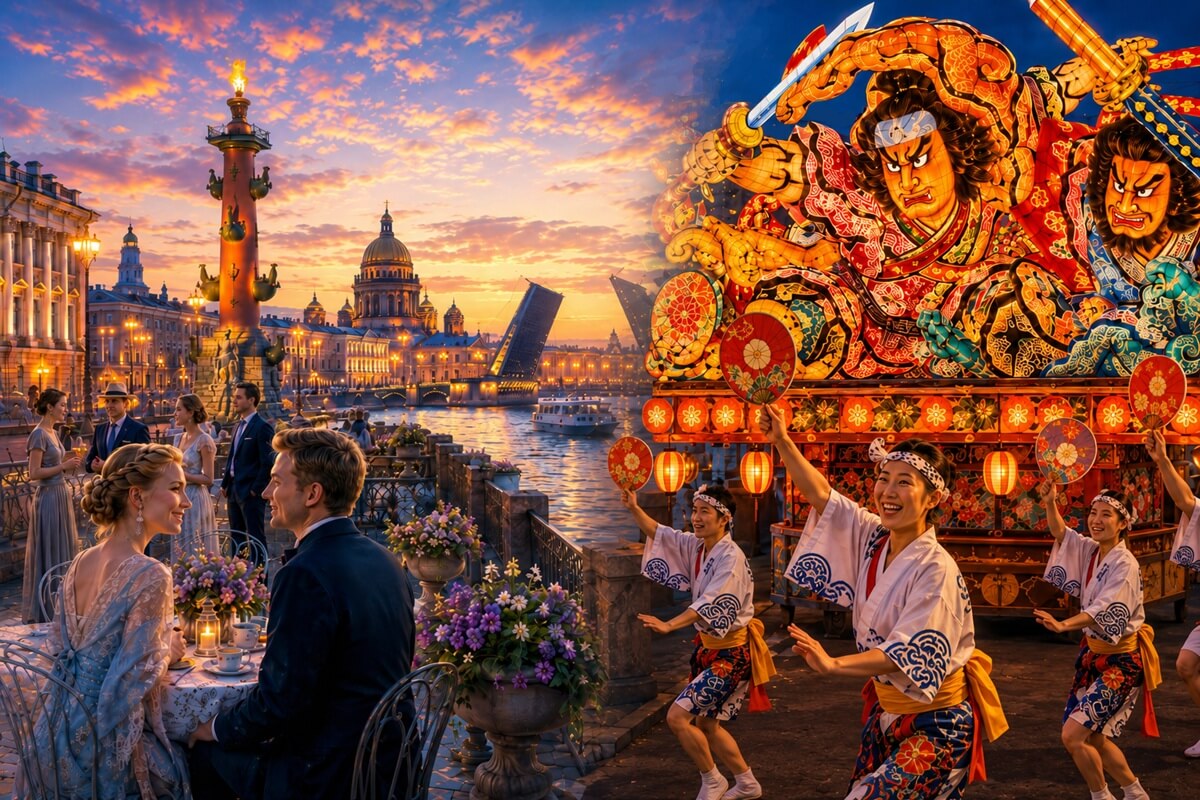
During the peak of summer, St. Petersburg experiences near-continuous daylight — the sun barely dips below the horizon, casting the city in a soft, golden glow that lasts through what would normally be the dead of night. For visitors, this means you can explore the city’s grand palaces, ornate cathedrals, and winding canals at midnight with the sun still lighting your way.
The city leans fully into the occasion. Firework displays, open-air concerts, and nightly performances of opera and ballet are all part of the White Nights season, which runs roughly from late May through mid-July. It’s no surprise that millions of tourists make the journey to experience it each year. Knowing a few phrases in Russian before you go will go a long way toward connecting with locals and making the most of the trip.
Aomori Nebuta Matsuri Festival, Japan
Japan is famous for its festival culture, and summer is one of the richest seasons for it. Among the country’s many matsuri (festivals), the Aomori Nebuta Matsuri stands out as one of the most visually breathtaking events in the entire country.
Held each year from August 2nd to 7th in Aomori City, in the far north of Japan’s main island, the festival centers on enormous illuminated floats depicting gods, warriors, and mythical creatures from Japanese folklore. These stunning structures are crafted from washi — a traditional Japanese handmade paper — stretched over wooden and wire frames and painted in vivid colors. Some floats take an entire year to build.
As darkness falls, the floats are paraded through the streets, glowing brilliantly from within. Crowds of haneto — costumed dancers — leap and spin alongside the floats to the thunderous beat of taiko drums and the melody of flutes. On the final evening, the top three prize-winning floats are loaded onto boats and paraded across the bay in a breathtaking finale. It’s a festival that truly has to be seen to be believed.
If you’re planning a visit, learning some Japanese beforehand will help you navigate the crowds, order food from local stalls, and connect with the people who pour their hearts into creating this extraordinary event.
Puck Fair in Killorglin, Ireland
Ireland’s reputation for celebrating in style is well earned, and summer is no exception. Tucked away in County Kerry on Ireland’s scenic southwest coast is the small town of Killorglin — and every August, it becomes the center of one of the country’s most charmingly unusual festivals: the Puck Fair.
The festival’s name comes from the Irish word poc, meaning billy goat, and the event’s star is exactly that — a mountain goat. Each year, a wild goat is captured from the surrounding hills, crowned with a ceremonial crown, and proclaimed King Puck for the duration of the three-day celebration. The goat is then placed on an elevated platform in the town square, presiding over the festivities below like a regal sovereign.
The exact origin of the tradition is lost to history, but one popular legend ties it to the Cromwellian conquest of Ireland in the 17th century. According to the story, a wild goat fleeing the advancing army stumbled into Killorglin, alerting the townspeople to the incoming threat and giving them precious time to prepare. The goat, in other words, became an unlikely local hero.
Beyond the royal goat, Puck Fair features a traditional horse fair, live music and céilí dancing, colorful parades, and fireworks. It’s a joyful celebration of Irish rural life and history — and a genuinely unique way to experience the country beyond the usual tourist trail.
Ghost Festival in China
Not all summer traditions are rooted in sunshine and celebration. In Chinese culture, the seventh month of the lunar calendar is known as Ghost Month — a time when the boundary between the living world and the spirit world is believed to dissolve.
According to tradition, the gates of the underworld open during this month, allowing the spirits of the deceased to walk among the living once more. To honor these returning souls and ensure they remain peaceful, families prepare offerings of food, paper money, and entertainment. Elaborate rituals are performed to show respect for ancestors and to prevent restless spirits from causing trouble for the living.
The highlight of Ghost Month falls on the 15th day — the Ghost Festival itself, known in Chinese as Zhongyuan Jie (中元节). On this night, glowing lanterns are set afloat on rivers and lakes, their soft light believed to guide wandering spirits back to their families. The sight of hundreds of paper lanterns drifting downstream in the dark is hauntingly beautiful.
The Ghost Festival is observed across much of East and Southeast Asia, including in Japan (where a similar tradition is known as Obon), as well as in Singapore, Malaysia, and Indonesia. While it may feel more solemn than the other festivals on this list, it offers a profound window into how Asian cultures approach memory, family, and the relationship between the living and the dead.
Why Learning the Local Language Makes All the Difference
Experiencing any of these traditions as an outsider is wonderful — but experiencing them with even a basic understanding of the local language transforms the entire trip. When you can read a sign, understand an announcement, or share a few words with a local, you stop being a spectator and start becoming a participant.
Whether you’re brushing up on your Japanese before the Nebuta Matsuri, learning some Swedish phrases before a Midsummer celebration, or picking up Russian to navigate St. Petersburg’s White Nights, language learning is one of the most meaningful investments you can make before any international adventure.
The world is full of extraordinary traditions just waiting to be discovered. Pick one, start learning the language, and go find it.