

From the outside, Korean names look simple: one family name followed by a two-syllable given name. But inside that pattern you find history, class, law, and even politics.
This post explains how Korean names developed, what they mean, and how common family names are distributed in the population today.
1. The Structure of Korean Names
Family name (surname)
Almost always one syllable in Hangul, written first.
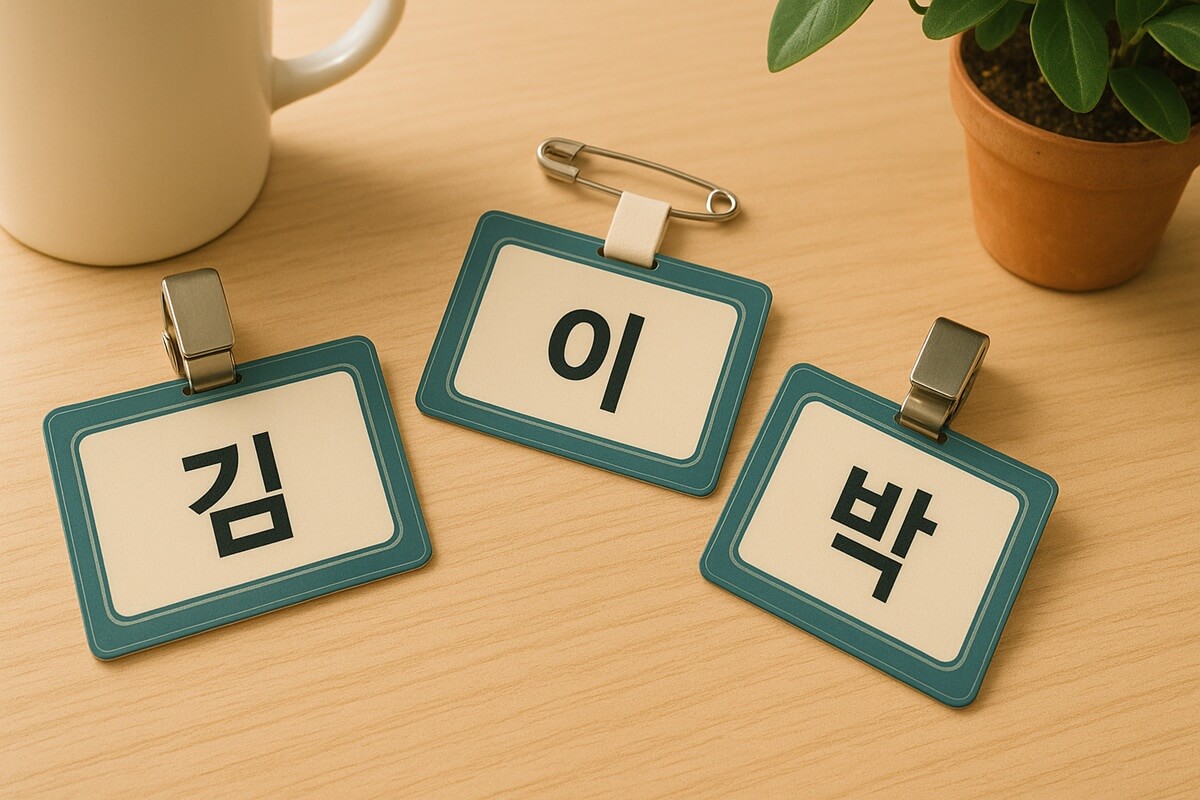
Common examples: 김 (Kim), 이 (Lee/Yi), 박 (Park).
Given name
Usually two syllables, often written together, such as 민준 (Minjun) or 서연 (Seoyeon).
Traditionally, each syllable corresponds to one Chinese character (hanja), each with its own meaning.
Example: 김민준 (Kim Minjun)
- 김 (Kim) – surname and clan identity
- 민 (Min) – can mean “clever,” “sharp,” or “quick,” depending on the hanja
- 준 (Jun) – often “talented,” “handsome,” or “outstanding”
Pure Korean given names
More recently, some parents choose pure Korean given names that use native Korean words in Hangul instead of hanja. For example:
- 하늘 (Ha-neul) – “sky”
- 아름 (Areum) – “beauty”
- 빛나 (Bitna) – “to shine”
These names often feel more modern, soft, and nature-inspired.
2. Historical Roots of Korean Surnames
Early use among elites
In ancient Korea, surnames began as a right of kings and aristocrats. During the Three Kingdoms period and later during the Unified Silla era, surnames were primarily used to mark noble status and royal lines.
Goryeo dynasty (918–1392)
Surnames, often tied to government positions or royal favor, were used increasingly by officials, scholars, and local elites.
Joseon dynasty (1392–1910)
Surnames became essential for:
- Confucian bureaucracy
- Genealogical records
- Taxation
- Land ownership
- Social rank
They were not just labels; they were part of the social system.
Commoners and the Gabo Reforms
Until the late 19th century, most commoners did not have a formal surname. This changed with the dissolution of the rigid class system.
After the Gabo Reforms of 1894, the right of ordinary people to adopt surnames was liberalized. Many chose:
- The surname of a powerful local clan or landlord
- A common name such as Kim or Lee
- A surname that was already widespread in their region
This wave of adoption is one reason modern Korea has such a high concentration of a few surnames.
3. Bon-gwan and the Clan System
Korean surnames are tightly coupled with bon-gwan (본관), the place of origin of a clan. This means two people with the same surname can belong to different bon-gwan:
- Gimhae Kim (김해 김씨)
- Gyeongju Kim (경주 김씨)
- Andong Kim (안동 김씨)
All are 김 (Kim), but they represent different historical lineages.
Key points about the clan system
- A clan is defined by surname + bon-gwan, not by the surname alone.
- Traditionally, people who had the same surname and bon-gwan were regarded as belonging to the same clan and treated one another as if close kin.
- Jokbo (족보) refers to family genealogies, which recorded birth, marriage, and death events across generations. These books reflected and reinforced clan identity.
According to Statistics Korea, as of the 2015 census there were about 1,507 surnames and 36,744 distinct clans in South Korea, showing how many separate lineages exist beneath a small set of common surnames.
4. Confucianism, Law, and Naming Rules
Same-surname marriage ban
Because surnames had historically been so limited, the state was concerned about marriages that might occur between people who could be related. From late Joseon onwards, the law prohibited marriage between people of the same surname and same bon-gwan, even if they were not close blood relatives.
This prohibition survived into modern South Korea. It wasn’t until 1997 that the Supreme Court ruled it unconstitutional, paving the way for many couples who had been living together but could not legally marry.
While the law no longer prevents such marriages, many older family members remain uncomfortable with same-clan marriages.
Japanese colonial rule and forced name changes
Names became a direct political issue during Japanese rule (1910–1945). In 1939–1940, the colonial government implemented a policy called Sōshi-kaimei:
- Koreans were compelled or effectively forced to take Japanese-style family names and often Japanese given names.
- This was part of a broader policy aimed at assimilating Koreans completely into the Japanese empire.
After liberation in 1945, the Name Restoration Order of 1946 allowed Koreans to reclaim their original family and given names, and most people did so.
5. How Concentrated Are Korean Surnames?
The “Big Three”: Kim, Lee, Park
Using detailed data from the 2015 South Korean census:
- Kim (김): About 10.6 million people (21.5%)
- Lee / Yi (이): Around 7.3 million people (14.7%)
- Park / Bak (박): About 4.19 million people (8.4%)
Put together, these three surnames account for approximately 44–45% of South Koreans.
Top 10 names and beyond
If you extend the list to the top 10 surnames, including:
- Choi (최)
- Jung / Jeong (정)
- Kang (강)
- Cho / Jo (조)
- Yoon (윤)
- Jang (장)
- Lim / Im (임/림)
…they cover about 64% of the population.
Why so few big surnames?
- Elite names copied downward: Commoners adopted surnames of prestigious clans.
- Limited formation of new surnames: Unlike Europe, Korea rarely formed new surnames.
- Clan structure and social stability: The share of big clans remained stable across centuries.
6. Meanings in Common Korean Surnames
- Kim (김 / 金): “Gold”; associated with royal lineages of Silla and Gaya.
- Lee / Yi (이 / 李): “Plum”; linked to Joseon royal family and others.
- Park / Bak (박 / 朴): “Simple” or “sincere”; associated with founder King Hyeokgeose and myth of the gourd.
Because of bon-gwan, one surname can have many different branches, each with its own origin story and migration path.
7. Given Names: Hanja, Hangul, and Modern Trends
Traditional hanja-based names
- Used hanja selected for meaning and auspiciousness.
- Included generation names and virtue/aspiration characters.
- Approved hanja are regulated by the government.
Rise of Hangul-only and pure Korean names
- Names that feel uniquely Korean, not Chinese-derived.
- Chosen for easier global pronunciation and creativity.
- Examples: 하늘 (Ha-neul – “sky”), 다솜 (Dasom – “love”), 서리 (Seori – “frost”)
8. Korean Names Today: Continuity and Change
Put it all together, and Korean names become a story of both strong continuity and rapid change.
- The family name system and clan structure date back centuries and are still visible today.
- Names like Kim, Lee, and Park still dominate the population.
- Given names have become more creative and globally minded, with many Hangul-only options now accepted.
If you meet someone named Kim Minjun or Park Seo-yeon, you are not just hearing a name. You are hearing a compressed record of clan history, Confucian tradition, colonial pressure, legal reform, and modern style, all wrapped into three short syllables.