

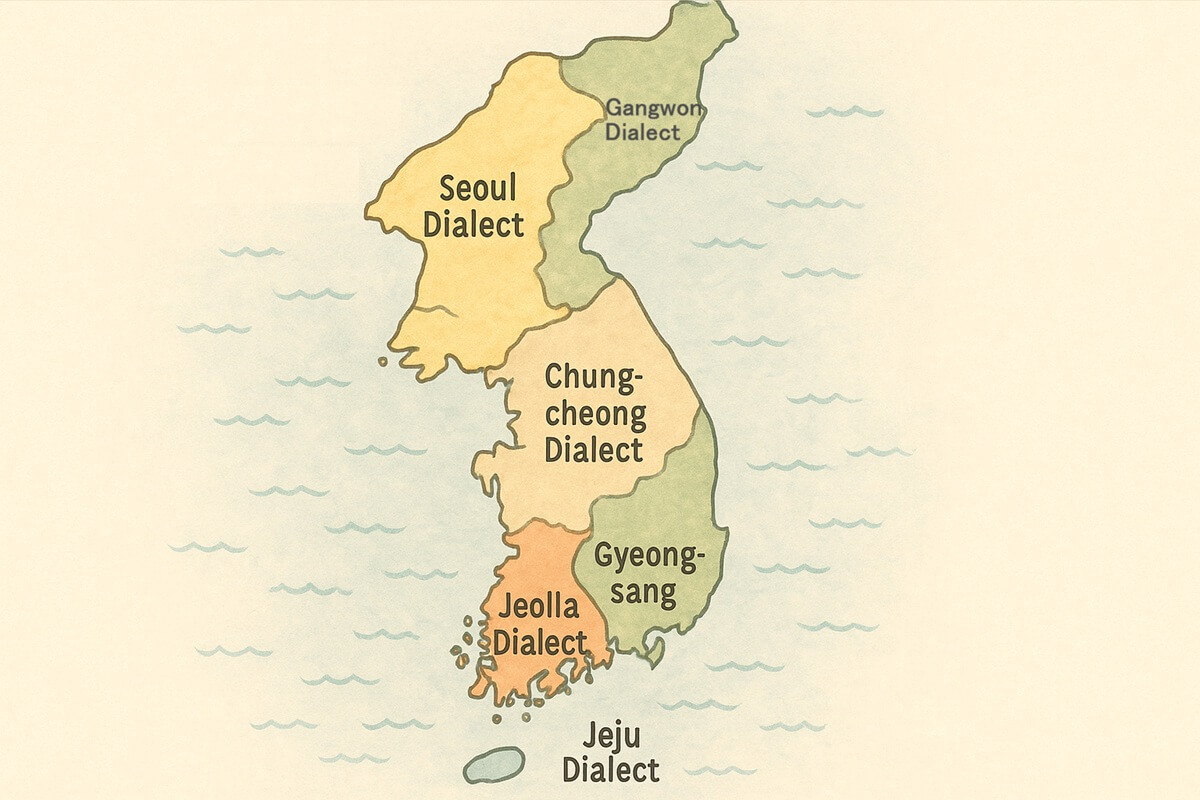
Korean might be one language, but it is far from uniform. From Seoul down to Jeju, Korea’s regional dialects, called satoori (사투리), add color, identity, and a whole lot of personality to everyday conversation. If you’ve ever watched a K-drama and wondered why one character suddenly sounds dramatically different, you’ve probably just come across a regional dialect.
Here’s a breakdown of the major Korean dialects, what makes them unique, and how to tell them apart.
1. Seoul Dialect (표준어 / Standard Korean)
Where: Seoul and most of Gyeonggi-do
Why it matters: This is the basis for South Korea’s standard language, used in media, education, and official settings.
What it sounds like: Clear pronunciation with a relatively neutral tone and less variation in pitch than some other dialects.
How to spot it: If it sounds like the textbook Korean you learned in class or heard on KBS News, it’s probably the Seoul dialect.
2. Gyeongsang Dialect (경상도 사투리)
Where: Southeastern Korea – Busan, Daegu, Ulsan
Vibe: Fast, punchy, and often described as “tough” or “assertive.”
- Strong pitch accent – somewhat similar to Japanese
- Intonation can sound almost melodic
- Different verb endings like “-데이” or “-노” instead of “-요”
Example:
Standard: 왜 그래요? (Why are you like that?)
Gyeongsang: 와 그라노?
How to spot it: It usually sounds more direct and intense. You’ll hear this in gritty K-dramas or anytime someone is yelling in a Busan action flick.
3. Jeolla Dialect (전라도 사투리)
Where: Southwestern Korea – Gwangju, Jeonju
Vibe: Drawn out, rhythmic, and sometimes described as a bit sly or playful in tone.
- Slower tempo
- Distinctive endings such as “~잉,” “~부러,” or “~랑께”
- Some vowel changes and pronunciation quirks
Example:
Standard: 진짜 맛있어요. (It’s really delicious.)
Jeolla: 진짜 맛있당잉.
How to recognize it: Jeolla speakers often sound more relaxed but still extremely expressive. The dialect has a distinctive sing-song rhythm that stands out once you get used to it.
4. Chungcheong Dialect (충청도 사투리)
Where: Central Korea – Daejeon, Cheongju
Vibe: Slow, relaxed, and sometimes even a little sleepy.
- Extended vowel sounds
- Often drops or softens final syllables
- Softer intonation and pacing overall
How to spot it: If it sounds like someone’s taking their sweet time to finish a sentence, it might be Chungcheong. There’s even a running joke in Korea that people from this region talk so slowly you forget what they were saying by the time they finish.
5. Gangwon Dialect (강원도 사투리)
Where: Northeastern Korea – Gangneung, Sokcho
Vibe: Rustic and similar to the Seoul dialect, but with a distinctive rural flavor.
- Some older Korean vocabulary is preserved
- Pronunciation quirks, especially in mountainous or rural areas
How to spot it: It’s subtler than other dialects but still distinguishable, especially among older speakers or in remote villages.
6. Jeju Dialect (제주 방언)
Where: Jeju Island
Vibe: Totally its own thing—almost like a separate language.
- Vocabulary that doesn’t exist in standard Korean
- Heavy influence from older forms of Korean and contact with other languages
- Almost incomprehensible to many Koreans on the mainland
Example:
Standard: 어디 가세요? (Where are you going?)
Jeju: 어드레 감수광?
How to spot it: If you think it’s not even Korean, you’re probably listening to Jeju dialect. It’s that different, which is why it’s listed as an endangered language by UNESCO.
Why Dialects Matter
Understanding Korean dialects is not only about language; it’s about culture, identity, and history. Dialects can signal where someone’s from, reveal generational differences, or even hint at class or profession. They’re also a rich source of humor, drama, and emotional depth in Korean media.
So whether you’re learning Korean, traveling, or just an avid fan of K-dramas and variety shows, tuning your ear to the dialects opens up a whole new level of appreciation.
Final Tip
If you want to learn dialects, start with Gyeongsang or Jeolla; both are commonly heard in dramas and variety shows. But don’t try them out on native speakers unless you’re confident. Getting satoori wrong can easily come across as mockery if you’re not careful.