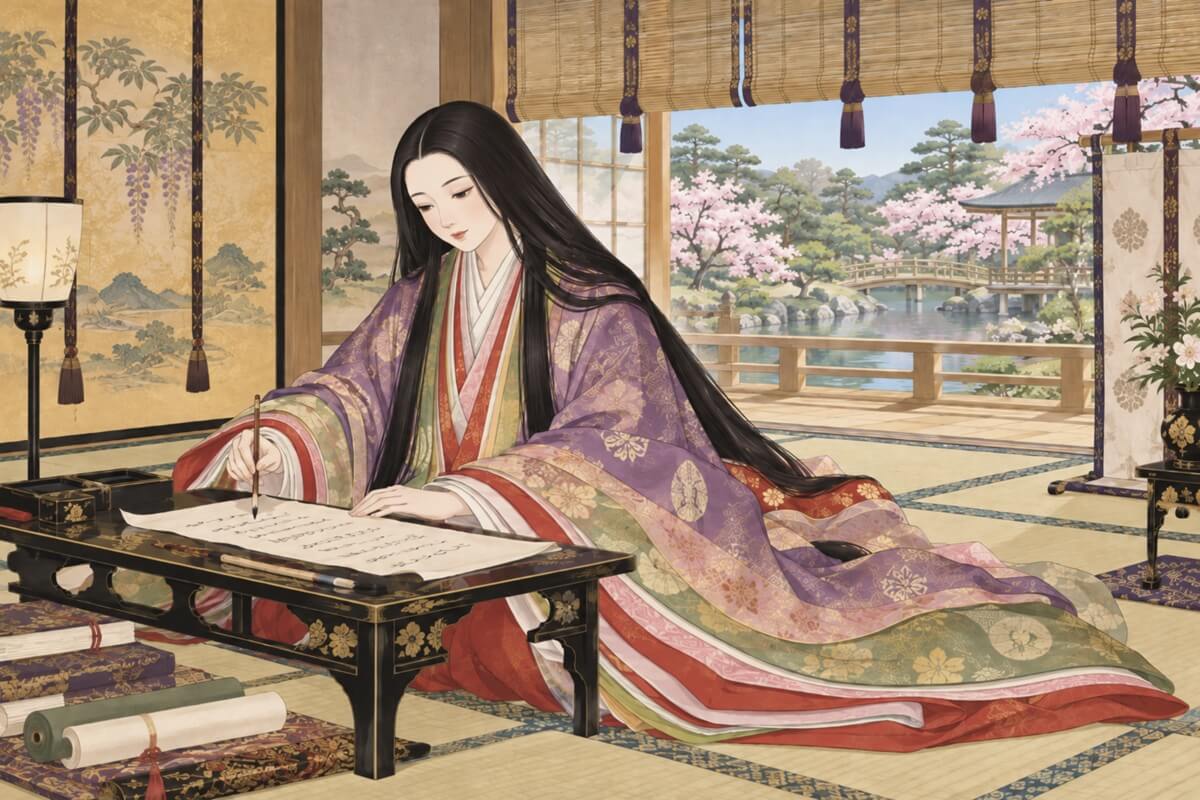
Imagine traveling back a thousand years to Kyoto and trying to have a conversation with someone at the imperial court. Even if you spoke fluent Japanese today, you might struggle to understand them. Familiar words would sound different, grammar would follow unfamiliar rules, and everyday expressions might seem strangely poetic.
Japanese has changed dramatically over the centuries. From ancient poetry written with Chinese characters to the elegant literature of the Heian period and the language spoken in modern Tokyo, its history is full of fascinating transformations. Let’s take a journey through time to discover how Japanese became the language we know today.
The Mysterious Origins of Japanese
Unlike English, German, or French, Japanese doesn’t belong to the Indo-European language family. Instead, it belongs to the Japonic family, which also includes the Ryukyuan languages spoken in Okinawa and nearby islands.
The exact origins of Japanese remain uncertain. Some linguists have proposed connections with Korean and other Asian languages, but no broader relationship has been conclusively established.
Our earliest substantial records of Japanese date to the eighth century, during the Nara period (710–794). Important works from this era include the Kojiki (712), the Nihon Shoki (720), and the Man’yōshū, a collection of more than 4,500 poems.
The language recorded in these texts is known as Old Japanese, or Jōdai Nihongo (上代日本語).
Surprisingly, Old Japanese had a different sound system from modern Japanese. While modern Japanese has five basic vowels, written evidence suggests that Old Japanese distinguished additional vowel-like sounds. Scholars continue to debate their exact pronunciation.
The Arrival of Chinese Characters
One of the biggest turning points in Japanese history was the introduction of Chinese characters, now known as kanji (漢字).
Chinese writing reached Japan through contact with the Asian mainland and became increasingly important by the fifth and sixth centuries.
However, Chinese and Japanese have very different grammatical structures. Chinese typically follows subject-verb-object word order, while Japanese places verbs at the end of sentences and uses particles to express grammatical relationships.
To represent their language, Japanese writers developed a system called man’yōgana (万葉仮名), which used Chinese characters for their sounds rather than their meanings.
Although effective, this system was complicated. Writing ordinary Japanese words could require several complex characters.
This eventually led to a much simpler way of writing Japanese.
The Birth of Hiragana and Katakana
During the Heian period (794–1185), two phonetic writing systems developed from Chinese characters: hiragana (ひらがな) and katakana (カタカナ).
Hiragana evolved from cursive Chinese characters, while katakana developed from abbreviated portions of those characters.
Hiragana became especially important in literature. It was closely associated with women at the imperial court, who produced some of Japan’s most celebrated literary works.
Around the beginning of the eleventh century, Murasaki Shikibu wrote The Tale of Genji (Genji Monogatari), often described as one of the world’s earliest novels. Sei Shōnagon also wrote The Pillow Book (Makura no Sōshi), a fascinating collection of observations about court life.
The Japanese used in these works became an important foundation for Classical Japanese, the language that modern students encounter when studying kobun (古文).
Classical Japanese: A Different Kind of Grammar
Classical Japanese may look familiar to modern Japanese learners, but its grammar can be surprisingly different.
For example, the modern Japanese verb miru (見る), meaning “to see,” becomes minai (見ない) in the negative form.
In Classical Japanese, however, the negative form could be mizu (見ず).
The classical negative ending -zu still survives in modern expressions such as shirazu (知らず), meaning “without knowing.”
Another distinctive feature was the auxiliary -keri (けり), which could express past events, recollection, or sudden realization.
Classical Japanese also had a grammatical system called kakari-musubi (係り結び), in which certain particles, including zo and koso, affected the ending of a sentence.
These rules have largely disappeared from everyday Japanese, but their influence remains visible in traditional literature, poetry, and fixed expressions.
How Japanese Pronunciation Changed
Japanese pronunciation has also changed considerably over time.
One interesting example involves the modern h sounds, represented by は, ひ, ふ, へ, and ほ.
Historical evidence suggests that these sounds developed from earlier p-like sounds, passing through f-like pronunciations in many contexts before reaching their modern forms.
This helps explain some unusual historical spellings.
For example, the Japanese word kawa (川), meaning “river,” was historically written かは rather than the modern かわ.
Similarly, kyō (今日), meaning “today,” was once written けふ.
These spellings reflect earlier stages of the language and remind us that Japanese pronunciation hasn’t always followed modern patterns.
From Samurai Japan to the Edo Period
As political power shifted from the imperial court to the samurai governments, Japanese continued to evolve.
During the Kamakura and Muromachi periods, spoken Japanese gradually moved away from classical grammatical patterns.
By the Edo period (1603–1868), everyday speech was significantly different from the Japanese of the Heian court.
Edo, now Tokyo, became a major urban center, and its growing population helped shape new forms of speech. Meanwhile, Kyoto and Osaka maintained their own influential linguistic traditions.
Regional differences remain important today. For example, while standard Japanese uses arigatō (ありがとう) for “thank you,” Kansai speakers may say ōkini (おおきに).
Despite these changes in spoken language, formal writing continued to preserve classical grammar for centuries.
This growing gap between written and spoken Japanese eventually led to a major reform movement.
The Meiji Period and Modern Japanese
When the Meiji period began in 1868, Japan experienced rapid modernization.
At the time, formal written Japanese was often very different from the language people actually spoke. Traditional texts relied heavily on Classical Chinese and classical Japanese grammar.
To address this, writers and intellectuals promoted genbun itchi (言文一致), a movement aimed at bringing written Japanese closer to everyday speech.
One important figure was Futabatei Shimei, whose novel Ukigumo (The Drifting Cloud), first published in 1887, helped popularize a more conversational writing style.
Over time, this movement transformed Japanese literature, journalism, and education.
Further changes came in the twentieth century. In 1946, Japan introduced modern kana spelling conventions and a standardized list of commonly used kanji.
Later reforms established the jōyō kanji list, which today contains 2,136 characters.
These developments helped shape the modern written Japanese used in schools, newspapers, and everyday communication.
Classical Japanese in the Modern World
Although Classical Japanese is no longer an everyday spoken language, it remains deeply connected to Japanese culture.
Students still study kobun to understand historical literature and poetry, including famous works such as The Tale of Genji and The Tale of the Heike.
Classical grammar also survives in modern expressions. The negative ending -zu, for instance, still appears in phrases such as shirazu (知らず).
Meanwhile, modern Japanese continues to absorb foreign vocabulary, particularly from English. Words such as konpyūtā (コンピューター, “computer”) and apuri (アプリ, “app”) are now part of everyday conversation.
From classical poetry to internet slang, Japanese continues to adapt to changing times.
Looking Ahead
The history of Japanese is a story of continuous change. From ancient Chinese characters to the invention of kana, from the sophisticated grammar of Classical Japanese to modern spelling reforms, each period has left its mark on the language.
Understanding this history can make learning Japanese even more rewarding. Every unusual particle, historical spelling, and traditional expression carries a small piece of the past.
So the next time you study a Japanese sentence or encounter a line of classical poetry, remember that you’re exploring a language that has been evolving for well over a thousand years—and its story is still being written.