

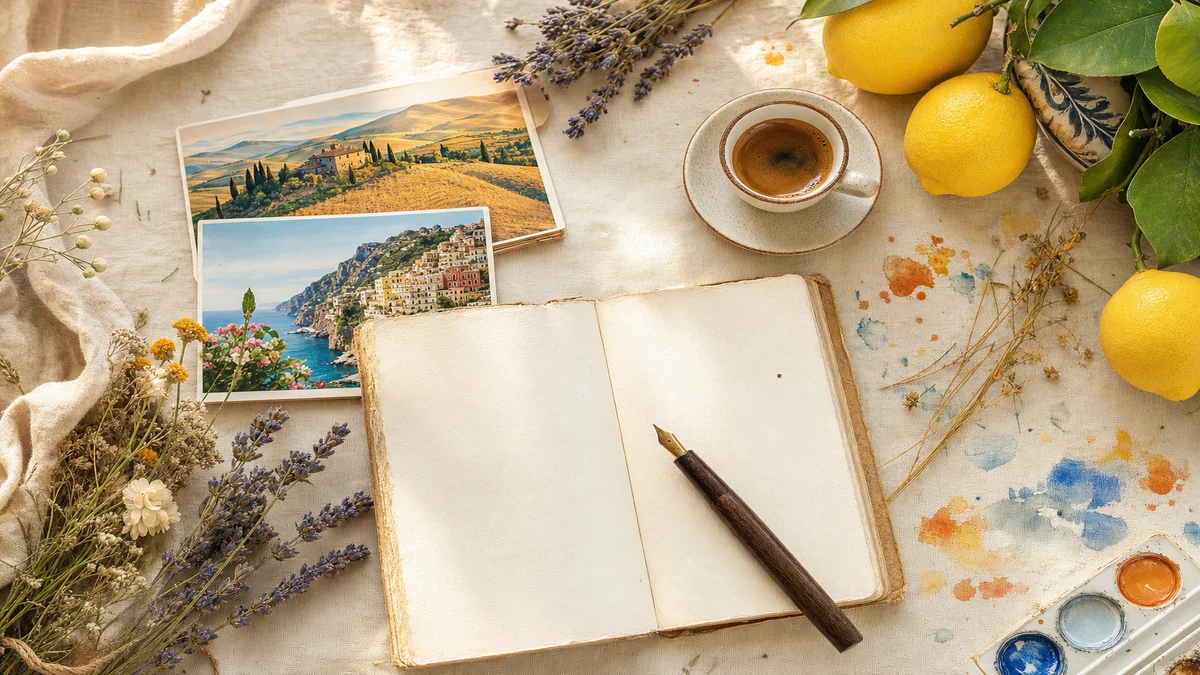
Close your eyes for a moment and imagine the sound of Italian being spoken in a sun-drenched piazza in Rome. Even if you don’t understand a single word, chances are it still sounds breathtaking. That’s no accident. Italian has long been celebrated as one of the most melodic, expressive, and emotionally rich languages in the world — and for good reason.
Italian words don’t just carry meaning; they carry feeling. They ripple through the air with a rhythm and warmth that few other languages can match. Whether you’re a beginner just starting your Italian journey or an intermediate learner looking to add some color to your vocabulary, exploring the most beautiful words the language has to offer is one of the most rewarding things you can do.
So, let’s take a stroll through some of the most gorgeous, expressive, and fascinating words the Italian language has to offer.
Why Italian Words Feel So Beautiful
Italian evolved from Latin and developed through centuries of poetry, music, art, and passionate everyday conversation. The language is phonetically very consistent — almost every letter is pronounced, vowels are open and clear, and words tend to end in vowel sounds that give sentences a lilting, musical quality.
It’s also a language deeply tied to emotion and culture. Italians have a remarkable ability to coin words that describe very specific human experiences — feelings and moments that other languages often need a whole sentence to explain. That’s part of what makes Italian vocabulary so rich and so worth exploring.
Beautiful Italian Words and Their Meanings
1. Abbiocco
You know that heavy, drowsy feeling that hits you after a big, satisfying meal? Italians have a perfect word for it: abbiocco. It describes that irresistible post-meal sleepiness — the kind that makes the couch look like the most inviting place on earth. There’s something deeply relatable and charming about a language that felt the need to name this very specific phenomenon.
2. Anima
Anima means “soul” or “spirit,” but it carries far more weight than a simple translation suggests. In Italian, anima speaks to the innermost essence of a person — their passions, their depth, their emotional core. You’ll find it woven throughout Italian literature, music, and everyday speech as a way to express something profoundly human.
3. Prego
If you’ve ever visited Italy or watched an Italian film, you’ve almost certainly heard prego. It’s one of those wonderfully versatile words that can mean “you’re welcome,” “after you,” “please go ahead,” or even “don’t mention it” — all depending on context. Mastering prego is one of the first steps to sounding naturally Italian in social situations.
4. Allora
Allora is the word you’ll hear constantly in natural Italian conversation. It functions a bit like the English filler words “so,” “well,” or “then,” and is used to bridge thoughts, signal a pause, or introduce the next part of a sentence. Native speakers use it so frequently that tuning your ear to allora can genuinely help you follow along in real conversations.
5. Mellifluo
If you want to describe a voice or sound that flows as smoothly and sweetly as honey, mellifluo is your word. Literally translating to “flowing with honey,” it describes any sound, voice, or piece of music that feels irresistibly smooth and melodious. Fittingly, the word itself sounds rather mellifluous when spoken aloud.
6. Fiabesco
Fiabesco describes something that feels like it belongs in a fairytale — magical, whimsical, and almost too beautiful to be real. Imagine standing before a mist-covered medieval village in Tuscany at dawn and reaching for the perfect word. Fiabesco would be exactly right. It captures that sense of wonder when reality briefly touches the realm of enchantment.
7. Fantasticheria
Related in spirit to fiabesco, fantasticheria refers to daydreaming or a fantasy — a state of imaginative wandering. It’s the word for those moments when your mind drifts away from the present and into a world of its own making. The great Italian author Giovanni Verga even used it as the title of one of his short stories.
8. Crepitio
Crepitio is the Italian word for crackling or rustling sounds — think the snap of a wood fire, the crinkle of autumn leaves underfoot, or rain tapping against a windowpane. It’s one of those words that almost sounds like the thing it describes, making it a joy to say and incredibly evocative when used in writing or conversation.
9. Sprezzatura
One of the most elegant concepts in the Italian language, sprezzatura describes the art of making something difficult look completely effortless. It was first coined in the 16th century by Baldassare Castiglione in his famous work The Book of the Courtier, where he described it as a kind of practiced nonchalance. Today, it remains a deeply Italian ideal — whether applied to fashion, cooking, or social grace.
10. Boh!
Sometimes, the most beautiful thing about a language is its ability to express uncertainty with complete style. Boh! is the Italian equivalent of a shrug — a single syllable that says “I have no idea” or “who knows?” without committing to anything further. It’s casual, expressive, and unmistakably Italian.
11. Daje and Dai!
These two exclamations are staples of energetic Italian expression. Daje (popular especially in Rome) is a rallying cry meaning “come on!” or “let’s go!” — the kind of word you’d hear echoing through a football stadium. Dai! is more versatile, functioning as encouragement (“go on!”), disbelief (“are you serious?”), or gentle protest, all depending on tone and context. Both words are a fantastic window into the expressive nature of colloquial Italian.
12. Innamorarsi
Perhaps one of the most romantically beautiful verbs in any language, innamorarsi means “to fall in love.” It rolls off the tongue with a warmth that perfectly matches its meaning. The related adjective innamorato/a describes someone who is smitten, head-over-heels, completely taken by another person. If Italian truly is the language of love, innamorarsi might be its most fitting ambassador.
13. Nuvola
Nuvola simply means “cloud,” but there’s something about the way it sounds — soft, floating, unhurried — that makes it feel like the word was crafted to match its meaning. It’s one of those vocabulary gems that reminds you how poetic everyday Italian can be, even when describing something as ordinary as the sky.
14. Onirico
Have you ever experienced a moment so surreal that it felt like it couldn’t possibly be real? Onirico is the word for that — it translates to “dreamlike” or “surreal” and is used to describe experiences, images, or scenes that blur the line between waking life and the world of dreams. It appears frequently in Italian cinema and literature for this very reason.
15. Tesoro
Literally meaning “treasure,” tesoro is also one of the most common Italian terms of endearment. Calling someone your tesoro is like calling them your darling or your sweetheart — a gesture of deep affection. It’s warm, intimate, and instantly recognizable as a word that carries love in every syllable.
16. Portafortuna
Portafortuna means “good luck charm” or “talisman” — an object believed to bring good fortune to its owner. The word itself is a beautiful compound: porta (carries) + fortuna (luck). It has a wonderful, almost musical quality when spoken, and reflects Italy’s rich tradition of superstition and symbolic objects.
17. Intramontabile
This elegant adjective means “timeless” or “enduring” — literally something that never sets, like a sun that refuses to sink below the horizon. Intramontabile is used to describe music, art, fashion, or memories that transcend time and remain as powerful and relevant as ever. It’s the perfect word for anything that simply refuses to fade.
18. Sornione
Sornione is a subtly rich word that goes beyond its dictionary translation of “sly” or “crafty.” In practice, it describes someone who masks their true thoughts or feelings behind a calm, pleasant exterior — not necessarily with bad intentions, but with a certain mysterious reserve. It’s the Italian word for a well-maintained poker face, with a hint of knowing charm.
19. Ultraterreno
Built from the prefix ultra (beyond) and terreno (earthly), ultraterreno describes something otherworldly or transcendent — beauty or experience so extraordinary it seems to come from beyond this world. A common phrase, bellezza ultraterrena, captures the idea of a beauty so stunning it feels supernatural.
20. Menefreghismo
This wonderfully expressive word comes from the phrase me ne frego, meaning “I couldn’t care less.” When compressed into the single noun menefreghismo, it describes an attitude of complete indifference — a kind of philosophical detachment from things that don’t matter. Depending on context, it can be used critically or admiringly, describing someone who is refreshingly unbothered or frustratingly apathetic.
21. Frangente
Originally a maritime term describing powerful, crashing waves at sea, frangente has sailed into everyday Italian usage to describe a difficult situation or a critical moment in time. It carries the weight of its nautical origins — a sense of turbulence, urgency, and the need to navigate carefully. It’s a word that adds drama and depth to any conversation.
22. Chiacchierare
Despite its slightly tricky spelling, chiacchierare is a delightfully fun word that means “to chat” or “to gossip.” Once you get the pronunciation down (roughly: kya-kye-RAH-reh), it becomes one of those words you’ll want to use all the time. It captures the relaxed, sociable spirit of Italian culture — the kind of long, unhurried conversations over espresso that Italians have perfected into an art form.
Tips for Making These Words Stick
Learning beautiful words is one thing — actually remembering and using them is another. Here are a few practical strategies to help these Italian gems become a natural part of your vocabulary:
- Use them in sentences: Don’t just memorize definitions. Write a short sentence using each new word as soon as you learn it. The context helps your brain retain the meaning far more effectively.
- Connect words to images or feelings: Many of the words above describe very specific sensations or emotions. When you learn abbiocco, picture the last time you felt that post-meal drowsiness. Personal associations make vocabulary memorable.
- Listen for them in the wild: Watch Italian films, listen to Italian music, or follow Italian podcasts. Pay attention to how native speakers naturally use words like allora, dai, and boh in real conversation.
- Practice speaking aloud: Italian is a phonetic language, and many of these words sound even more beautiful when spoken. Say them out loud — not just in your head. Your mouth needs practice too.
- Group related words together: Notice how fiabesco and fantasticheria share a dreamlike theme, or how innamorarsi and tesoro both orbit around love and affection. Learning words in thematic clusters can strengthen recall.
The Joy of Learning Italian Vocabulary
What makes Italian vocabulary so rewarding to explore is the way it reflects a culture that has always valued beauty, passion, and the art of living well. From the post-lunch drowsiness of abbiocco to the timeless elegance of sprezzatura, the Italian language offers words that don’t just communicate — they paint pictures, evoke feelings, and tell stories.
Every new word you add to your vocabulary is a small window into Italian life and culture. And the more windows you open, the richer your understanding of the language — and the people who speak it — becomes.
So keep exploring, keep practicing, and don’t be afraid to sprinkle a little mellifluo magic into your Italian conversations. The language is waiting for you — and it sounds absolutely beautiful.