
If you’re learning Korean, late summer is a good time to add one word to your vocabulary list: 추석 (Chuseok).
In 2026, Chuseok falls on Friday, September 25, with the official holiday running from Thursday, September 24 through Saturday, September 26. For many people who normally have weekends off, that means a break stretching through Sunday as well.
And with Chuseok now less than a month away, you’ll soon start seeing words like 추석 연휴, 귀성길, and 송편 in Korean news, advertisements, social media posts, and everyday conversations.
So rather than simply asking “What is Chuseok?”, let’s look at the holiday through the eyes of a Korean learner: what it means, how people celebrate it today, and—most importantly—what Korean you can actually use.
First: What Is 추석?
추석 (Chuseok) is one of Korea’s most important traditional holidays. It takes place on the 15th day of the eighth month of the lunar calendar, so its date changes each year on the Gregorian calendar.
Historically, Chuseok was connected with the autumn harvest. Families celebrated the year’s abundance, shared newly harvested foods, and honored their ancestors.
Today, family remains at the center of the holiday for many Koreans, but the way people spend Chuseok varies widely. Some families continue traditional ancestral rituals, while others have simplified them or stopped doing them altogether. Some people travel, meet relatives for a meal, take a vacation, or simply use the long weekend to rest.
In other words, Chuseok is both a traditional Korean holiday and a modern Korean holiday—and understanding both sides gives you a much more realistic picture of Korea today.
Is Chuseok Really “Korean Thanksgiving”?
You will often see Chuseok described in English as “Korean Thanksgiving.”
It’s a useful shortcut, but it isn’t a perfect translation.
Both holidays are associated with harvest, gratitude, family gatherings, and plenty of food. But Chuseok also has customs connected with ancestor remembrance, the lunar calendar, and traditions that are uniquely Korean.
So if someone asks you what Chuseok is, saying “It’s a little like Korean Thanksgiving” can be helpful.
Just remember:
추석 = 추석.
Sometimes learning a culture means learning when not to translate something too literally.
Another Name You’ll Hear: 한가위
Chuseok is also called 한가위 (Hangawi), a traditional Korean name for the holiday.
You may come across it especially in holiday greetings and advertisements:
풍성한 한가위 보내세요.
Have a bountiful Hangawi.
즐거운 한가위 되세요.
Have a happy Hangawi.
In normal conversation, however, 추석 is the word you’ll probably hear most often.
2026 Chuseok at a Glance
For 2026, the key dates are:
- September 24, Thursday: Chuseok holiday
- September 25, Friday: Chuseok
- September 26, Saturday: Chuseok holiday
Chuseok itself is always surrounded by public holidays on the day before and the day after.
Because millions of people use the holiday period to visit family or travel, transportation can become extremely busy. Train tickets, domestic flights, and intercity buses are often in high demand.
If you’re going to be in Korea during Chuseok 2026, check transportation and opening hours early rather than assuming everything will operate normally.
7 Korean Words That Make Chuseok Easier to Understand
Here’s where Chuseok becomes especially useful for Korean learners.
1. 명절 — Traditional Holiday
명절 refers to an important traditional holiday such as Chuseok or Seollal.
You might hear:
명절에 뭐 하세요?
What do you do during the holiday?
명절 음식
holiday food
It’s a useful word because Koreans don’t always say “Chuseok” specifically when talking about holiday traditions in general.
2. 연휴 — Consecutive Holidays / Long Weekend
You’ll see 연휴 everywhere before Chuseok.
추석 연휴 means “the Chuseok holiday period.”
For example:
이번 추석 연휴에 뭐 할 거예요?
What are you going to do over the Chuseok holiday?
This is much more natural Korean than trying to translate “Chuseok vacation” word for word.
3. 고향 — Hometown
For many Koreans, Chuseok is associated with returning to one’s 고향, or hometown.
고향에 내려가요.
I’m going down to my hometown.
Notice the verb 내려가다, “to go down.” Koreans often use 올라가다 and 내려가다 when talking about travel between Seoul and other parts of the country, not simply literal elevation.
4. 귀성길 — The Trip Home for the Holiday
This is a word you may encounter in Korean news every Chuseok.
귀성길 refers to the journey people make back to their hometowns for a major holiday.
You might see a headline mentioning:
추석 귀성길 교통 상황
Chuseok homebound traffic conditions
If you see television footage of crowded expressways before Chuseok, there’s a good chance you’ll hear this word.
5. 귀경길 — The Trip Back After the Holiday
And after 귀성길 comes 귀경길.
This refers to the return journey after visiting one’s hometown, especially the flow of people returning toward Seoul and other major cities.
Learning 귀성길 and 귀경길 as a pair is an easy way to remember them.
6. 송편 — Chuseok Rice Cakes
If Chuseok had an official food, it would probably be 송편 (songpyeon).
Songpyeon are small rice cakes traditionally filled with ingredients such as sesame, beans, red beans, or chestnuts. They are often steamed with pine needles, which give them a distinctive aroma.
They’re especially associated with Chuseok, so you’ll begin seeing beautifully packaged boxes and colorful varieties in the weeks before the holiday.
7. 보름달 — Full Moon
보름달 means “full moon.”
Chuseok takes place on the 15th day of the eighth lunar month and has long been associated with the harvest moon.
Traditionally, people looked at the Chuseok moon and made wishes.
A useful expression is:
보름달을 보면서 소원을 빌다
to make a wish while looking at the full moon
Here, 소원을 빌다 means “to make a wish.”
How Do You Say “Happy Chuseok” in Korean?
The easiest and most natural expression for Korean learners is:
추석 잘 보내세요!
Have a great Chuseok!
The verb 보내다 normally means “to send,” but when talking about time, holidays, or special occasions, 잘 보내다 means “to spend it well” or “have a good time.”
You can also say:
즐거운 추석 보내세요!
Have a happy Chuseok!
Or, in a more traditional holiday message:
풍성한 한가위 보내세요!
Have a bountiful Hangawi!
The adjective 풍성하다 means “abundant,” “plentiful,” or “bountiful,” making it especially appropriate for a harvest holiday.
For most everyday situations, though, you don’t need anything complicated.
추석 잘 보내세요! works perfectly.
What Do Koreans Traditionally Do on Chuseok?
If you’re learning about Korean culture, there are several traditional customs worth recognizing.
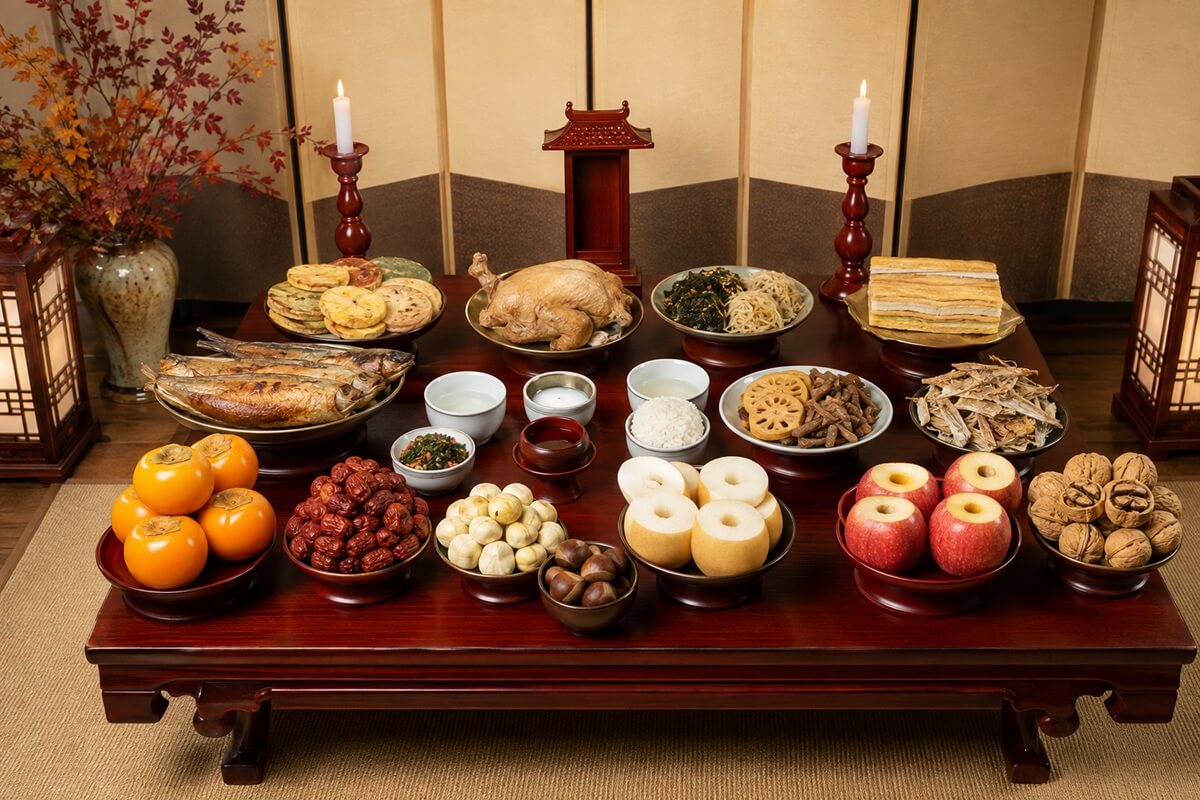
차례 — Ancestral Memorial Rite
차례 (charye) is a traditional ritual honoring deceased ancestors.
Families may prepare food and place it on a special table before bowing and paying their respects. Foods vary by family and region, but rice, fruit, songpyeon, jeon, and other dishes may be included.
One important point, however, is that not every Korean family performs 차례 today.
Holiday customs have been changing as families become smaller and attitudes toward traditional rituals evolve. A 2025 survey by the Korea Rural Economic Institute found that 40.4% of respondents planned to prepare a charye table that Chuseok, down substantially from a decade earlier.
So it’s better to say:
“Some Korean families perform 차례 during Chuseok.”
Rather than:
“Koreans perform 차례 during Chuseok.”
That small difference makes your Korean cultural knowledge much more accurate.
성묘 and 벌초 — Visiting and Caring for Ancestral Graves
성묘 means visiting an ancestor’s grave to pay respects.
벌초 refers to cutting the grass and clearing the area around ancestral graves, often done before Chuseok.
These traditions reflect the importance of remembering previous generations in Korean family culture.
What Do People Eat?
Chuseok food varies from household to household, so there’s no single mandatory menu.
But several dishes are strongly associated with holiday meals.
송편
The iconic Chuseok rice cake.
Making songpyeon together has traditionally been a family activity, although plenty of people now simply buy them from a 떡집—a rice cake shop.
전
전 are pan-fried dishes made with ingredients such as vegetables, meat, fish, or other fillings.
Around Chuseok, preparing large quantities of 전 can be almost as famous as eating them.
갈비찜
갈비찜 is braised short ribs cooked until tender in a savory-sweet sauce.
It’s commonly served for special occasions and family gatherings.
잡채
Glass noodles stir-fried with vegetables and other ingredients.
잡채 isn’t exclusive to Chuseok, but it’s a familiar sight at Korean celebration tables.
The useful Korean phrase here is:
명절 음식
holiday food
Chuseok in Korea Today: Family Holiday, Travel Season, or Both?
Traditional images of Chuseok often show several generations gathered around a large table, making songpyeon and performing ancestral rites.
That image is still part of Korean culture—but it isn’t everyone’s Chuseok.
Modern families may have a shorter gathering, eat at a restaurant instead of cooking all day, send gifts through mobile apps, take a domestic or overseas trip, or spend the holiday quietly at home.
That makes Chuseok an interesting example of how culture changes without disappearing.
Words such as 가족, 고향, and 조상 are still closely connected with the holiday, while words like 여행, 휴식, and even 해외여행 increasingly appear in conversations about how people plan to spend their break.
If you’re learning Korean, noticing those changes is just as valuable as memorizing traditional customs.
Final Thoughts
Chuseok is much more than a public holiday — it’s a living expression of Korean identity, values, and heritage. From the ancestral rites at dawn to the moonlit circle dances at night, every part of the celebration carries meaning that has been carefully preserved across millennia.
Whether you’re learning Korean, planning a visit, or simply curious about the world’s cultures, Chuseok offers a rich and rewarding subject to explore. And the next time someone wishes you 추석 잘 보내세요, you’ll know exactly what they mean — and maybe even wish them a happy and prosperous Hangawi right back.