
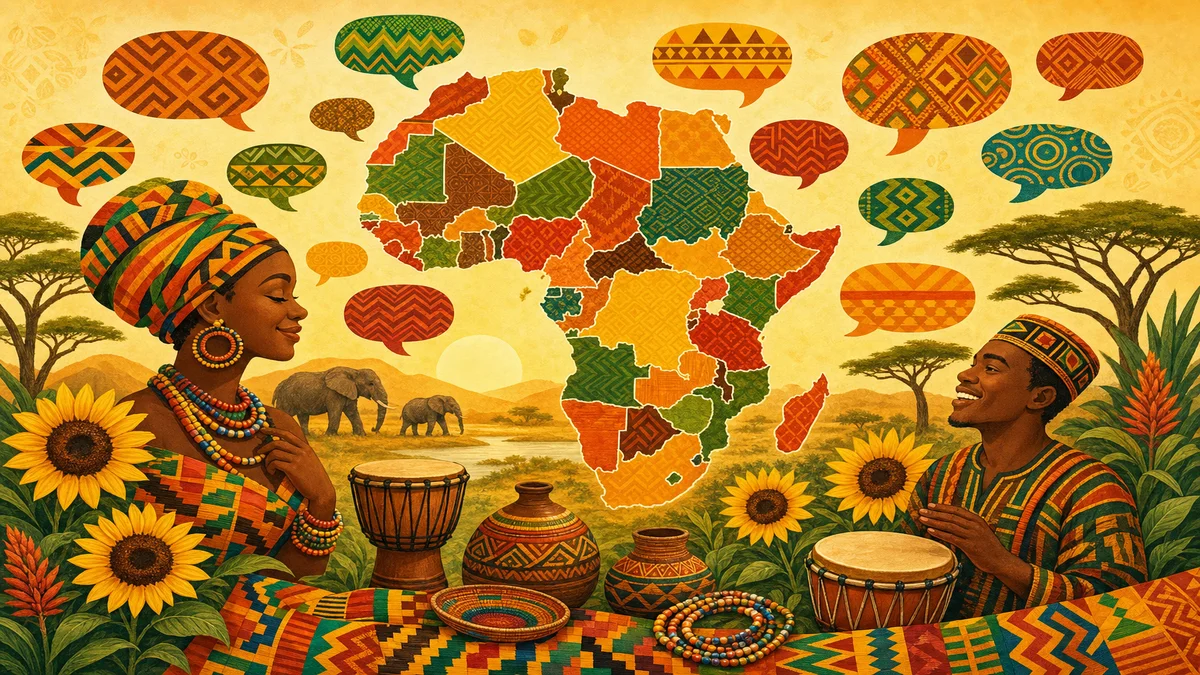
If you had to guess how many languages are spoken across the African continent, what number would you pick? A few hundred, maybe? The actual answer might genuinely surprise you — and it speaks volumes about just how linguistically rich and culturally diverse Africa truly is.
Africa is widely regarded by scientists and historians as the birthplace of humanity itself. It follows, then, that the continent would also be home to some of the oldest and most varied languages on Earth. Whether you’re planning a visit to Africa, reconnecting with your heritage, or simply curious about the world’s languages, understanding Africa’s linguistic landscape is a fascinating journey in itself.
How Many Languages Are There in Africa?
Here’s where things get staggering. Africa is made up of 54 countries, so you might reasonably expect somewhere in the range of 50 to 100 languages across the continent. But the real number is far beyond that — linguists estimate that nearly 2,000 distinct languages are spoken in Africa, with some experts pushing that figure closer to 3,000 when regional dialects are included.
Part of the reason it’s so difficult to pin down an exact number is that some languages are spoken only in extremely remote communities, making them hard to document and study. This linguistic diversity is not just impressive on paper — it reflects thousands of years of distinct cultural evolution, migration, trade, and storytelling traditions happening simultaneously across a vast continent.
Rather than attempt an impossible complete list, let’s explore some of the most widely spoken and culturally significant languages in Africa, and follow their remarkable reach across the globe.
Swahili: The Language of East Africa
Swahili is one of the most widely spoken languages on the African continent and serves as a lingua franca across much of East Africa, including Kenya, Tanzania, Uganda, and the Democratic Republic of Congo. Its roots are a fascinating blend of Bantu languages — spoken by the indigenous peoples of the East African coast — and Arabic, the result of centuries of trade between coastal African communities and merchants from Arabia and Persia.
You’ve almost certainly used a Swahili word without realizing it. The word safari, now universally associated with wildlife adventures, comes directly from Swahili, which borrowed it from the Arabic word safar (سفر), meaning “journey” or “travel.”
Here are a few everyday Swahili phrases worth knowing:
- Jambo — Hello
- Kwa heri — Goodbye
- Polepole — Slow down (literally “slowly, slowly”)
- Haba na haba hujaza kibaba — “Little by little, the pot is filled” (a popular proverb encouraging patience and persistence)
That last phrase is a great one to keep in mind if you’re in the middle of learning a new language — progress happens one small step at a time.
Zulu: A Language Like No Other
The Zulu language is spoken primarily by the Zulu people of South Africa and is one of the country’s 11 official languages. It was first written down by European missionaries, who transcribed it using a phonetic Latin script — a practice common across Africa during the colonial era.
What makes Zulu particularly remarkable is its use of click consonants — sounds produced by clicking the tongue against different parts of the mouth. This feature, shared with other Southern African languages like Xhosa and the Khoisan languages, makes Zulu one of the most phonetically distinctive languages in the entire world, not just in Africa.
Want to wish someone a happy birthday in Zulu? You’d say Halala ngosuku lokuzalwa! And if someone wished you the same, the appropriate response would be ngiyabonga — meaning “thank you.”
Egyptian Arabic: A Language Heard by Millions
Egyptian Arabic is spoken by more than 100 million people, making it one of the most widely spoken Arabic dialects in the world and a dominant language across North Africa. Unlike Modern Standard Arabic, which is used in formal writing and broadcasting throughout the Arab world, Egyptian Arabic is the everyday spoken language of Egypt — and thanks to Egypt’s massive film, television, and music industry, it’s broadly understood by Arabic speakers across the Middle East and North Africa.
The language has deep historical roots, drawing on ancient Egyptian as well as Classical Arabic, along with influences from Coptic, Greek, Turkish, French, and English accumulated over thousands of years of civilization and conquest. For anyone interested in North African culture, commerce, or history, Egyptian Arabic is an incredibly rewarding language to explore.
Twi: Language of the Akan People
In southern and central Ghana, the Twi language is spoken by the Akan people and holds an important place in Ghanaian culture and daily life. One of its most charming traditions involves how children are named: among Twi-speaking Akan communities, a child’s first name is traditionally determined by the day of the week on which they were born.
For example, a boy born on a Friday would be named Kofi, while a girl born on the same day would be named Afia. Each day of the week has its own corresponding male and female names, a practice that connects a person’s identity directly to the moment they entered the world.
This tradition is a beautiful example of how language and cultural identity are deeply intertwined — something you’ll find throughout Africa’s linguistic heritage.
European Languages in Africa: A Colonial Legacy
Africa’s linguistic story cannot be told without acknowledging the profound impact of European colonialism. During the 19th century’s so-called “Scramble for Africa,” European powers divided the continent among themselves, imposing their own languages as the languages of government, education, and trade.
Today, French is an official language in more than 20 African countries, including Cameroon, Benin, Togo, and Madagascar. Portuguese is spoken in Cape Verde, Mozambique, Angola, and São Tomé and Príncipe. English is widely used across East, West, and Southern Africa. Arabic dominates North Africa, while Spanish is spoken in Equatorial Guinea.
These languages exist alongside — and sometimes in tension with — indigenous African languages, reflecting a complex history whose effects are still very much felt today.
African Languages Beyond Africa: The Diaspora’s Linguistic Legacy
The forced migration of millions of Africans during the transatlantic slave trade created something unexpected and remarkable from a linguistic perspective: entirely new languages. As enslaved people from different African nations were thrown together and forced to communicate with their colonizers, new hybrid languages called Creoles emerged. These languages blended African vocabulary and grammar with European languages in ways that were creative, adaptive, and deeply human.
Bajan Creole: The Voice of Barbados
Bajan Creole, spoken in Barbados, is built on an English base but is richly layered with influences from French, Spanish, Portuguese, and numerous African languages. It is its own distinct and vibrant form of communication, not simply a broken version of English.
A few examples reveal its fascinating mixed heritage:
- Mési — meaning “thanks,” borrowed from the French word merci
- Pickney — meaning “small child,” derived from the Spanish pequeño and French petit, both meaning “small”
These word origins tell a story of cultural collision and human resilience — communities forming new ways of communicating and expressing identity under extraordinarily difficult circumstances.
Jamaican Patois: More Than a Dialect
Jamaican Patois (also called Jamaican Creole) is arguably the most internationally recognized Caribbean Creole language, thanks in large part to the global reach of Jamaican music, culture, and diaspora communities. It’s a phonetically written language with no single standardized spelling system, and it varies by region across the island.
One of its most interesting features is compound word creation — combining existing words to form new ones that describe concepts vividly. For example:
- Yeye-wata — meaning “tear” (literally “eye water”)
- Nose-ole — meaning “nostril” (literally “nose hole”)
Jamaican Patois also preserves a striking number of words rooted directly in West African languages:
- Nyam — meaning “to eat,” believed to derive from the Wolof language
- Duppy — meaning a malevolent ghost or spirit, thought to be connected to the word adope from the Ga language of Ghana
- Anansi — meaning “spider,” from the Akan language, also the name of the famous West African trickster spider deity
- Unu — the plural form of “you,” directly related to the Igbo pronoun únù
These linguistic threads connect the Caribbean directly back to Africa in ways that are both moving and academically significant.
Gullah: Africa Preserved on American Shores
One of the most remarkable surviving African-influenced languages in the United States is Gullah, also known as Sea Island Creole. Spoken by communities along the coastal areas of South Carolina, Georgia, and northeastern Florida, Gullah developed among enslaved Africans who were brought to these isolated coastal regions to work on rice and indigo plantations.
Because these communities were relatively isolated from the broader American population for generations, they were able to preserve African linguistic elements to a degree found almost nowhere else in the United States. Gullah contains over 300 loanwords from various African languages, and its grammar, vocabulary, and sentence structure share more in common with African languages than with standard English.
You may have encountered Gullah without knowing it. The refrain of the well-known spiritual hymn Kumbaya is actually a Gullah phrase meaning “Come by here.”
The Gullah language has also been sustained through a rich oral tradition of storytelling — a reminder of how deeply important narrative and community memory are to linguistic survival.
The Taino Influence: Indigenous Caribbean Words in Everyday English
Before the transatlantic slave trade reshaped the Caribbean, the islands were home to indigenous peoples, most notably the Taino. Though colonization and disease devastated their population, the Taino language left permanent marks on the English language through Spanish, which absorbed many Taino words before passing them along.
Words you use regularly that come from the Taino language include:
- Hurricane — from the Taino word hurakán, meaning “god of the storm”
- Potato — from the Taino word batata, their word for a type of yam or sweet potato
- Hammock, canoe, tobacco, maize — all Taino in origin
This quiet persistence of indigenous vocabulary is a testament to the enduring power of language, even when the communities that created it have been largely lost to history.
Why Africa’s Languages Matter to All Language Learners
Exploring African languages — whether you’re studying Swahili, discovering the click consonants of Zulu, or tracing the African roots of Jamaican Patois — opens a window onto thousands of years of human history, movement, and connection. Language is never just vocabulary and grammar; it’s a record of who people are, where they’ve been, and how they’ve shaped the world around them.
The languages of Africa and the African diaspora are living proof of that. From the trading routes of the East African coast to the shores of the Caribbean and the Sea Islands of the American South, African languages have traveled the world — and they continue to evolve and thrive today.
So whether you’re just beginning your language learning journey or looking to explore something entirely new, Africa’s incredible linguistic diversity has something to offer every curious learner. The next time you go on a safari, dodge a hurricane, or hear someone singing Kumbaya, you’ll know exactly where those words came from — and the rich, resilient human story behind them.