Introduction
Learning a language from a textbook can be helpful. Learning a language through food is unforgettable.
When you cook in the language you’re learning, vocabulary stops being abstract. It’s not just the word картофель (potato). It’s peeling it, boiling it, tasting it. The words become tangible — sensory and emotional.
Food also teaches culture in a way grammar charts can’t. A recipe reveals what people celebrate, how they gather, and what “home” means to them.
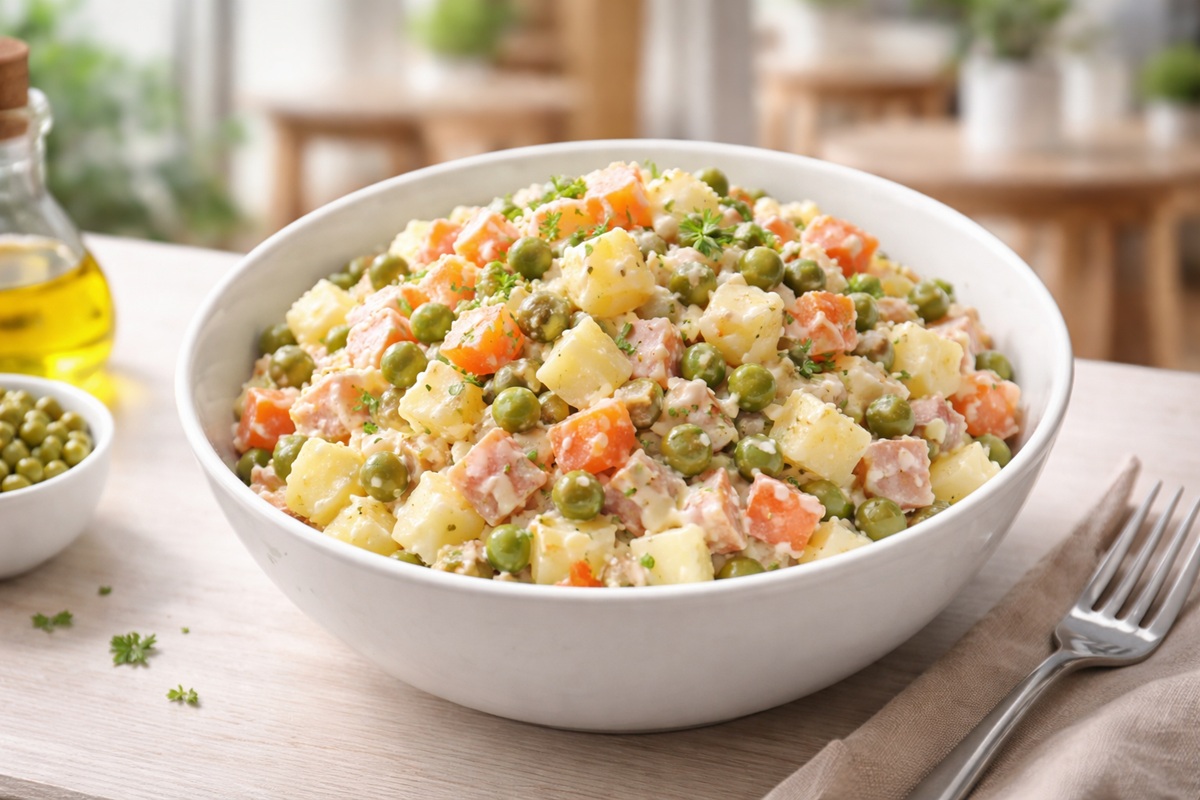
In this article, you’ll learn Russian through one of Russia’s most iconic dishes: Olivier salad, known in Russian as салат Оливье.
By the end, you’ll know how to make Olivier salad using Russian instructions. You’ll learn how to pronounce key words, understand common cooking verbs, and practice with a short dialogue and exercises.
Let’s begin with why this dish matters in Russia.
The Cultural Story Behind Olivier Salad
In Russian, Olivier salad is called:
салат Оливье
salát Olivye
Olivier salad was invented in Moscow in the 1860s by a Belgian-French chef named Lucien Olivier. The original version was luxurious and included expensive ingredients such as game meats. Over time, the recipe became simpler and more accessible.
Today, Olivier salad is especially associated with New Year’s Eve. If you visit a Russian home on December 31st, there’s a very good chance you’ll see Olivier salad on the table.
It represents comfort, nostalgia, and tradition — all in one bowl.
For language learners, it’s ideal because:
- It contains everyday food vocabulary.
- It includes common cooking verbs.
- The instructions are repetitive and practical.
- The context is real-life and cultural.
Now, let’s look at the recipe.
The Olivier Salad Recipe (English Version First)
Ingredients
- 3–4 medium-sized potatoes
- 3 carrots
- 4 eggs
- 3–4 pickles
- 1 can of peas
- 300 g cooked sausage (bologna-style works well)
- 1 small onion (optional)
- 200–250 g mayonnaise
- Salt and pepper to taste
Instructions
- Boil the potatoes and carrots. Let them cool.
- Boil the eggs. Let them cool, then peel them.
- Cut all ingredients into small cubes.
- Drain the peas.
- Mix everything together.
- Add mayonnaise, salt, and pepper.
- Stir well.
- Refrigerate for at least one hour before serving.
Simple — and delicious.
Now let’s turn this into a Russian lesson.
Key Ingredients in Russian (With Pronunciation Guide)
Below are key ingredients written in:
- Cyrillic
- Transliteration
- English meaning
- Pronunciation tips
Potatoes
картофель
kartófelʹ
Potato
Pronunciation tip:
- Stress is on the second syllable: kar-TO-fel.
- The soft sign (ь) is not pronounced as a vowel, but it softens the preceding consonant.
Carrot
морковь
morkóvʹ
Carrot
Pronunciation tip:
- Stress on the second syllable: mor-KOV.
- The final consonant is softened by the soft sign.
Egg
яйцо
yaytsó
Egg
Pronunciation tip:
- Begins with a “ya” sound.
- Stress on the last syllable: yay-TSO.
- The letter ц sounds like “ts” in “cats.”
Plural:
яйца (yáytsa) – eggs
Pickle
солёный огурец
solyóny oguréts
Pickled cucumber
Pronunciation tip:
- ё is always pronounced “yo.”
- Stress: so-LYO-ny o-gu-RETS.
Peas
горошек
goróshek
Peas
Pronunciation tip:
- Stress on the second syllable: go-RO-shek.
- ш sounds like “sh” in “shoe.”
Sausage
колбаса
kolbasá
Sausage
Pronunciation tip:
- Stress on the final syllable: kol-ba-SA.
- Unstressed “o” sounds closer to “a.”
Onion
лук
luk
Onion
One short, clear syllable.
Mayonnaise
майонез
mayonéz
Mayonnaise
Pronunciation tip:
- Stress on the last syllable: ma-yo-NEZ.
- йо flows smoothly together.
Salt and Pepper
соль – solʹ – Salt
перец – pérets – Pepper
Essential Cooking Verbs in Russian
Cookbooks are full of verbs — and this is where grammar becomes practical.
| Russian | Transliteration | Meaning |
|---|---|---|
| добавить | dobávitʹ | to add |
| посолить | posolítʹ | to salt |
| поперчить | poperchítʹ | to pepper |
| охладить | okhladítʹ | to cool |
Many Russian infinitives end in -ить or -ать. These are common verb endings.
The Recipe Instructions in Russian
Now let’s rewrite the recipe in Russian.
1. Boil the Vegetables
Отварите картофель и морковь.
Otvaríte kartófelʹ i morkóvʹ.
Boil the potatoes and carrots.
Note:
- Stress falls on -РИ- in “отварите.”
- This is an imperative verb (a command form).
2. Boil the Eggs
Сварите яйца.
Svaríte yáytsa.
Boil the eggs.
3. Dice Everything
Нарежьте картофель, морковь, яйца и колбасу.
Narézhte kartófelʹ, morkóvʹ, yáytsa i kolbasú.
Dice the potatoes, carrots, eggs, and sausage.
4. Add Peas and Mayonnaise
Добавьте горошек и майонез.
Dobávʹte goróshek i mayonéz.
Add peas and mayonnaise.
5. Mix Well
Хорошо перемешайте.
Khoroshó peremesháyte.
Mix well.
6. Refrigerate
Поставьте в холодильник на час.
Postávʹte v kholodílnik na chas.
Put it in the refrigerator for an hour.
Mini Grammar Focus: Imperative Verbs in Recipes
Russian recipes use imperative verbs — command forms.
Examples:
- варить → варите (boil)
- добавлять → добавьте (add)
- нарезать → нарежьте (cut)
You’ll often see verbs ending in:
- -ите
- -йте
- -ьте
These endings indicate commands. Most recipes rely heavily on the imperative form.
Unlike English, Russian verbs change form depending on aspect and verb type. Reading recipes is excellent practice for noticing these patterns.
What You Learn From This Recipe Linguistically
This single recipe teaches more than vocabulary.
1. Word Stress Matters
Russian stress is unpredictable:
- колбаса – kolbaSA
- картофель – karTOfel
Stress affects vowel clarity and meaning.
2. The Soft Sign (ь)
In words like:
- картофель
- соль
- морковь
The soft sign doesn’t create its own sound, but it softens the preceding consonant.
3. Perfective Verbs
Most recipe verbs are perfective:
- добавить – to add
- нарезать – to cut
- сварить – to boil
Recipes describe completed actions. You boil the eggs once. You add mayonnaise once. This makes recipes a practical introduction to aspect.
4. Case in Action
In:
Нарежьте картофель.
“картофель” appears in the accusative case. Recipes give you repeated exposure to direct objects in action.
Common Pronunciation Mistakes English Speakers Make
Here are some common mistakes.
Mispronouncing “ё”
Incorrect:
солёный – so-LEH-ny
Correct:
солёный – so-LYO-ny
“ё” always sounds like “yo.”
Ignoring Word Stress
Incorrect:
колбаса – KO-lba-sa
Correct:
колбаса – kol-ba-SA
Overpronouncing Unstressed “o”
Unstressed “o” sounds closer to “a.” This reduction is essential in natural Russian speech.
Neglecting Soft Consonants
Incorrect:
соль – “soul”
Correct:
соль – “solʹ” (with a softened final consonant)
Try reading the ingredient list aloud while cooking.
Dinner Table Dialogue (Using Our Vocabulary)
You’re at a New Year’s dinner in Moscow.
- Аня:
-
Попробуй салат Оливье.
Popróbuy salát Olivye.
Try the Olivier salad. - Марк:
-
Очень вкусно. Ты сама готовила?
Óchenʹ vkúsno. Ty samá gotóvila?
Very tasty. Did you make it yourself? - Аня:
-
Да. Я варила картофель и яйца, потом добавила майонез.
Da. Ya varíla kartófelʹ i yáytsa, potóm dobávila mayonéz.
Yes. I boiled potatoes and eggs, then added mayonnaise. - Марк:
-
Можно ещё немного?
Mózhno yeshchó nemnógo?
May I have a little more?
Short. Natural. Practical.
FAQ: Learning Russian Through Olivier Salad
What is Olivier salad?
Olivier salad is a traditional Russian salad made of boiled vegetables, eggs, pickles, sausage, peas, and mayonnaise. It is especially popular on New Year’s Eve.
What is the Russian word for “salad”?
салат
salát
Stress falls on the second syllable.
Is Olivier salad a traditional Russian dish?
Yes. It has been part of Russian holiday meals for over a century and is closely associated with New Year’s celebrations.
What verb forms do Russian recipes use?
Russian recipes primarily use imperative verbs such as:
- нарежьте (cut)
- добавьте (add)
- сварите (boil)
These forms instruct the reader to perform an action.
Final Thoughts: Cook It. Say It. Own It.
Language isn’t just something you speak — it’s something you do.
When you:
- Chop картофель
- Say Добавьте майонез out loud
- Serve салат Оливье
You’re not just studying Russian. You’re using it.
So here’s your challenge:
- Cook the salad.
- Read the Russian instructions aloud.
- Notice the stress.
- Feel how the sounds move in your mouth.
Food slows you down. Repetition makes language stick.
The next time someone says Попробуй салат Оливье, you’ll know exactly what they mean — and you’ll be ready to answer.
Приятного аппетита.