
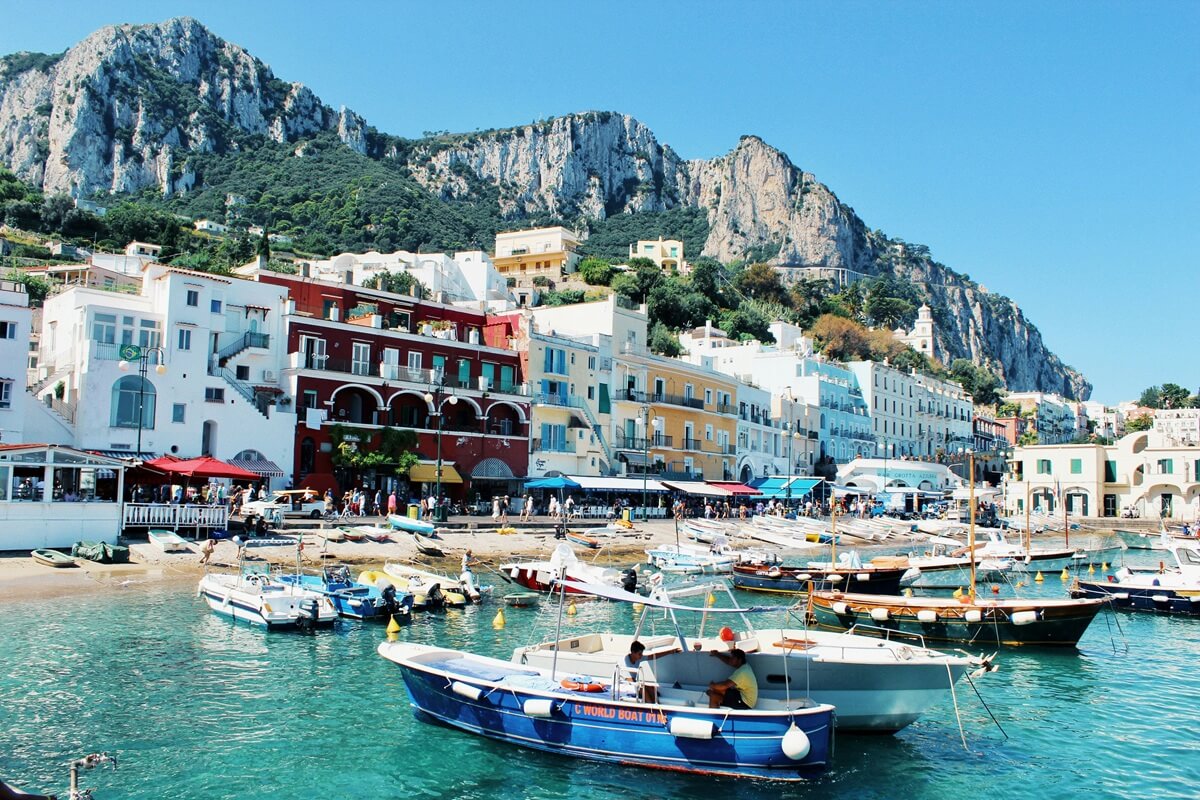
Capri is the kind of place that makes you want to slow down.
You order a cappuccino in a small piazza. You walk past whitewashed houses and bright bougainvillea. You watch the sun set behind the Faraglioni rocks. And somewhere between your second cappuccino and your evening stroll, you think to yourself: this is the perfect place to learn Italian.
Not in a classroom far from the action. But right here, in the middle of it.
Here’s how to turn your trip to Capri into a language-learning experience you’ll actually enjoy.
Why Capri Is a Great Place to Practice Italian
Capri is a small, walkable island with plenty of opportunities for interaction. And that matters.
In a large city like Rome, it’s easy to blend into the crowd and default to English. But in a smaller place like Capri—especially outside peak tourist hours—interactions feel more personal. The same barista might serve you twice in one day. A shop owner may recognize you when you return. A waiter might take a moment to chat.
Capri is located in the region of Campania, so you may also hear the expressive Neapolitan accent and local influences in everyday speech. Even if people speak standard Italian, the rhythm and musicality of southern Italy are part of the experience.
You don’t need to be fluent. You just need to be willing to try.
Learn the Basics Before You Arrive
You don’t need to master Italian before your trip. But knowing a few key phrases will completely change your experience.
Here are some essentials to learn before you go:
- How to greet people: Buongiorno (good morning), Buonasera (good evening)
- How to be polite: Per favore (please), Grazie (thank you)
- How to order food: Vorrei… (I would like…), Posso avere…? (Can I have…?)
-
How to ask simple questions:
Quanto costa? (How much does it cost?)
Dove si trova…? (Where is…?)
Try saying them aloud before your trip. Italian has a musical quality. The more familiar you are with its sounds, the more confident you’ll feel using it.
Turn Everyday Moments Into Mini Lessons
You don’t need a classroom to learn a lot. Capri itself can become your classroom.
1. At the Café
Order in Italian—even if the waiter speaks English.
Instead of:
“One cappuccino, please.”
Try:
“Un cappuccino, per favore.”
Listen carefully to the reply. Repeat phrases quietly to yourself. Small repetitions build confidence.
2. At the Market
If you visit a small grocery store or fruit stand, try asking:
“Che cos’è questo?” (What is this?)
You’ll quickly learn the names of foods—tomatoes, lemons, mozzarella. Lemons and limoncello are especially famous in Capri.
These simple exchanges stick with you because they’re connected to real experiences.
3. On a Boat Tour
If you take a boat tour around the island—especially to the famous Grotta Azzurra (Blue Grotto)—ask the guide a simple question in Italian.
Even something as small as:
“È bellissima.” (It’s beautiful.)
can open the door to a brief conversation.
That’s real-world practice.
Consider a Short Language Course Nearby
If you’re spending more time in Italy, consider enrolling in a short language course.
Many programs in southern Italy offer:
- 1–2 week intensive courses
- Small group lessons
- Cultural activities like cooking classes or guided walks
If your school isn’t located on Capri itself, you can easily reach nearby cities like Naples or Sorrento by boat. You could stay near Capri and commute a few days a week.
Take a few structured lessons to build your confidence—then practice on the island.
Learn Italian Through Food
Food is one of the best teachers in Italy.
Instead of just pointing to something on the menu, ask what it is. Try to understand the ingredients. Repeat the name aloud.
You might encounter dishes such as:
- Insalata Caprese
- Ravioli Capresi
- Fresh seafood like calamari and pesce fresco
If a waiter explains something in Italian and you understand even half of it, that’s progress.
And yes, you will make mistakes. That’s part of learning.
Stay Somewhere Local
Instead of staying at an international hotel chain, consider a small hotel or family-run B&B.
When you arrive, practice your Italian by asking a few simple questions:
- “A che ora è la colazione?” (What time is breakfast?)
- “Avete un consiglio per la cena?” (Do you have a dinner recommendation?)
These conversations tend to move at a slower pace, giving you time to process and respond.
Accept That It Will Feel Awkward
At first, speaking Italian may feel uncomfortable. You might hesitate. You might forget a verb ending. Someone may switch to English.
Keep going.
Most Italians appreciate the effort. It changes the dynamic. You’re no longer just a tourist—you become a guest.
And that makes a difference.
Make It Personal
Words are easier to remember when they connect to something meaningful.
Think about what you love and learn vocabulary related to it.
If you love photography, learn words like:
- luce (light)
- ombra (shadow)
If you love food, learn ingredient names.
If you enjoy hiking, learn words related to paths, cliffs, and views.
Capri provides the setting. Your interests provide the motivation.
A Simple Daily Plan for Learning Italian in Capri
If you like structure, try this simple plan:
Morning:
Review 10 new words over coffee.
Midday:
Order lunch using only Italian.
Afternoon:
Write down 5 new words or phrases you hear.
Evening:
Have one conversation in Italian—no matter how short.
Simple. Practical. Effective.
The Real Reward of Learning Italian in Capri
Learning Italian in Capri isn’t about memorizing grammar rules.
It’s about hearing the language echo through narrow streets. It’s about understanding a joke just enough to laugh along. It’s about reading a handwritten menu without needing a translation.
When you leave Capri, you’ll remember the view.
But you’ll also remember the words.
And the next time you return, you won’t just feel like a visitor.
You’ll feel a little more at home.