

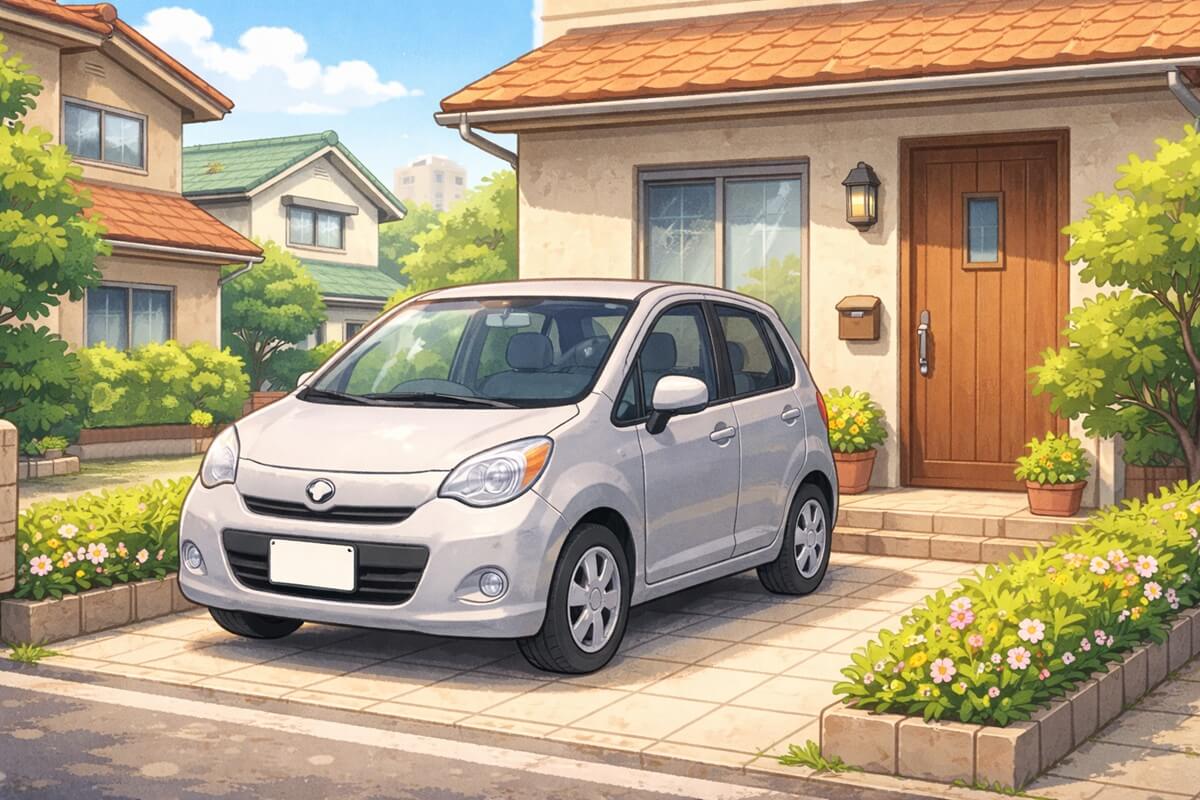
One of the first surprises for Japanese language learners is that “location” isn’t expressed with a single all-purpose preposition like in or on. Instead, Japanese typically combines a place + a position word (a noun) and then chooses a particle that matches what the sentence is doing.
It can feel abstract at first. But once you learn the core pattern, it becomes very logical.
Let’s break it down step by step.
The Core Pattern for Location Phrases
Most location phrases in Japanese follow this structure:
[Place] + の + [Position word] + [Particle]
Position words are nouns, not prepositions. That’s a big mental shift for English speakers.
Here are a few common position words:
- 上{うえ|ue} — on / above
- 下{した|shita} — under / below
- 前{まえ|mae} — in front of
- 後{うしろ|ushiro} — behind
- 中{なか|naka} — inside
- 横{よこ|yoko} — beside / next to
- 近{ちか|chika}く — near
Examples of the Pattern
- 机{つくえ|tsukue}の上{うえ|ue} — on the desk
- 学校{がっこう|gakkou}の前{まえ|mae} — in front of the school
- 車{くるま|kuruma}の下{した|shita} — under the car
So far, we’ve only built the location phrase.
The next step is the important part:
The particle at the end is where meaning really changes.
に: Where Something Exists
Use に to mark the location where something exists.
You’ll commonly see に with these verbs:
- ある — to exist (generally for inanimate things)
- いる — to exist (for people and animals)
Examples (existence)
本{ほん|hon}は机{つくえ|tsukue}の上{うえ|ue}にあります。
The book is on the desk.
猫{ねこ|neko}は車{くるま|kuruma}の下{した|shita}にいます。
The cat is under the car.
In these sentences, nothing is happening. You are simply stating where something is.
Where is it? → に
で: Where an Action Happens
Use で to mark the location where an action takes place.
In this case, the location functions as the setting for an activity.
Examples (action)
駅{えき|eki}で待{ま|ma}ちます。
I’ll wait at the station.
公園{こうえん|kouen}で遊{あそ|aso}びます。
I play in the park.
店{みせ|mise}の前{まえ|mae}で写真{しゃしん|shashin}を撮{と|to}りました。
I took a photo in front of the store.
Where does the action take place? → で
Comparing 上に and 上で
This is where many learners get stuck, so let’s compare them directly.
上に (existence)
テーブルの上{うえ|ue}にケーキがあります。
There is a cake on the table.
→ You are describing where the cake exists.
上で (action)
テーブルの上{うえ|ue}でケーキを切{き|ki}りました。
I cut the cake on the table.
→ You are describing where the action happens.
Same location.
Same position word.
Different particle.
Different meaning.
に vs で with People
The same logic applies when talking about people.
Existence (に)
先生{せんせい|sensei}は教室{きょうしつ|kyoushitsu}にいます。
The teacher is in the classroom.
Action (で)
先生{せんせい|sensei}は教室{きょうしつ|kyoushitsu}で話{はな|hana}しています。
The teacher is speaking in the classroom.
Note on 前に vs 前で
Both 前{まえ|mae}に and 前{まえ|mae}で can be correct. The difference comes from the particle, not the position word.
前に (existence)
家{いえ|ie}の前{まえ|mae}に車{くるま|kuruma}があります。
There is a car in front of the house.
前で (action)
家{いえ|ie}の前{まえ|mae}で待{ま|ma}ってください。
Please wait in front of the house.
If you’re unsure, ask yourself one simple question:
Is this sentence about “being,” or “doing”?
- Being (existence) → に
- Doing (action) → で
Common Beginner Mistake
Many learners try to translate directly from English:
“I study at the café” → カフェに勉強{べんきょう|benkyou}します ❌
This sounds unnatural in Japanese because studying is an action.
Correct:
カフェで勉強{べんきょう|benkyou}します。 ✅
I study at the café.
Japanese focuses less on matching English prepositions like in, on, or at, and more on the function the location plays in the sentence.
Conclusion
To express location in Japanese:
- Use position nouns such as 上, 前, and 中
- Choose に for existence
- Choose で for actions
Once you stop translating English prepositions directly and start thinking in terms of existence vs action, Japanese location expressions become clear and consistent.
And the best part is:
This logic works at every level of Japanese, from beginner to advanced.