
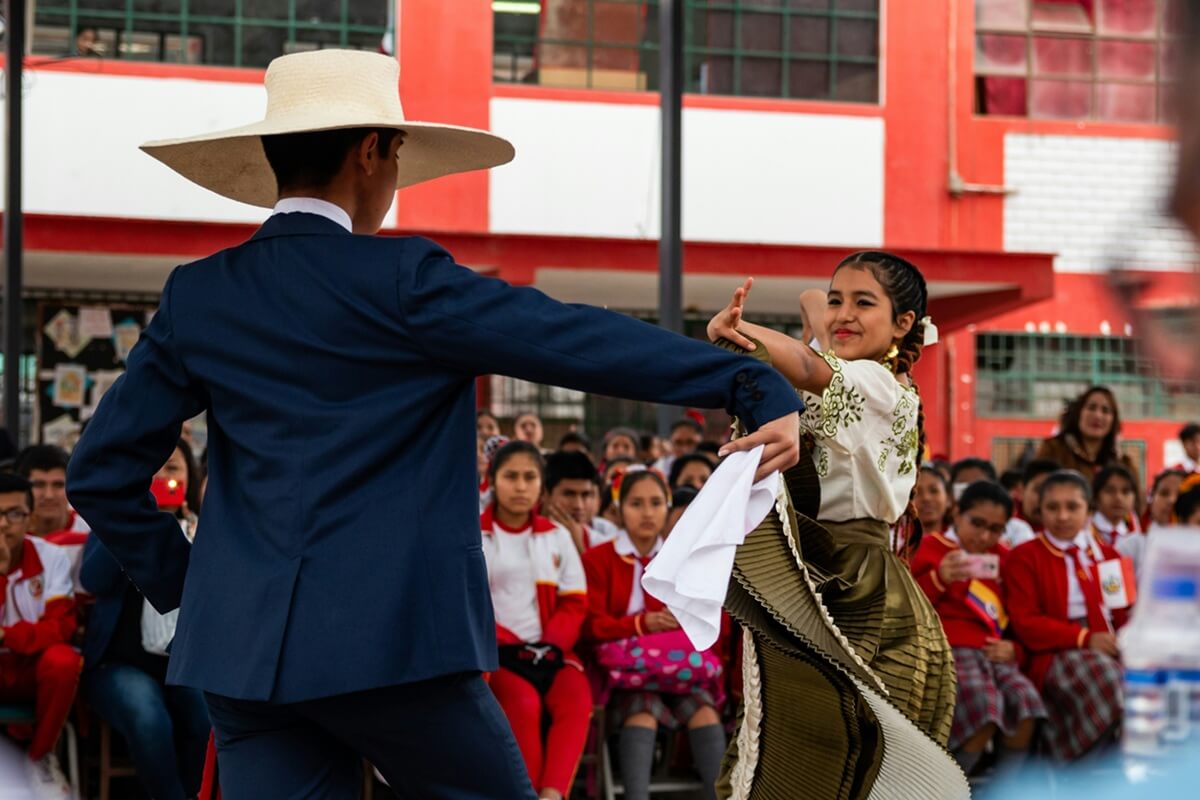
If you’ve ever taken a salsa or bachata dance class, you’ve probably noticed something interesting: even before you know much Spanish, you start recognizing words.
“Derecha.” “Izquierda.” “Otra vez.”
At first, those sounds can feel fast and frustrating. But after a few classes, they start to feel familiar—and eventually, natural.
That’s not a coincidence. Latin dancing and Spanish learning reinforce each other in a way most apps can’t replicate. On the dance floor, Spanish stops being abstract. It becomes physical, social, and connected to real moments your brain can remember.
In this post, you’ll see exactly how dance classes can support Spanish speaking and listening—especially if you’re a beginner who wants more confidence and real-world exposure.
You Learn Spanish Vocabulary Without Even Trying
In a dance class, Spanish vocabulary usually isn’t introduced through flashcards. It’s linked to action.
When the instructor calls “giro” and you turn, the word attaches to the movement. When you hear “pausa” and the whole class freezes, the meaning becomes clear instantly. You don’t have to translate. You understand.
That kind of learning can be powerful because it mirrors how we learned our first language as children. Instead of memorizing definitions, we connected sounds to experiences—again and again—until the meaning stuck. Dance classes recreate that process in a low-pressure way.
Over time, you naturally pick up a small but useful set of words:
- Numbers for counting rhythms (uno, dos, tres…)
- Directions (derecha, izquierda)
- Body parts (mano, pie)
- Timing and speed words (rápido, despacio)
- Repetition and sequence phrases (otra vez, ahora, después)
Later, when you start studying Spanish more formally, these words won’t feel new. They’ll feel familiar—and that reduces the “this is too hard” feeling that makes many learners quit early.
Your Ear Gets Used to the Sound of Spanish
One of the hardest parts of learning Spanish is understanding it at full speed. Real Spanish doesn’t arrive one word at a time. It flows.
Latin dance helps more than most people expect because it trains your ears before your grammar catches up.
Dance music and dance instruction expose you to:
- Spanish rhythm and pacing
- Common pronunciation patterns
- Repeated phrases and familiar sounds
- The feel of stressed syllables and vowel sounds
Even if you don’t understand every lyric, your brain starts learning the shape of Spanish. You begin noticing where words “land,” how phrases rise and fall, and how sounds blend together.
Later, when you hear Spanish outside a classroom—on a street, in a café, in a video—it doesn’t sound like noise. It sounds like something you’ve heard before.
That familiarity is a huge advantage for listening comprehension.
You Practice Listening Under Pressure (Like Real Life)
It’s easy to listen in a quiet environment. Real life isn’t quiet.
People talk quickly. There’s background noise. Someone interrupts. Your brain has to keep up.
Dance classes naturally simulate that “real-life listening” environment:
- Music is playing
- People are moving around you
- You’re watching the instructor
- You’re trying not to step on anyone
- You still need to understand the directions
That means you’re practicing Spanish while your attention is divided—exactly like real conversations.
At first, it can feel like too much. But over time, your brain gets better at catching meaning through tone, gesture, context, and key words. That’s one of the biggest skills in real-world Spanish.
You Get Comfortable Making Mistakes (Which Helps You Speak)
A major reason people struggle with Spanish speaking is fear.
They worry about pronunciation. They worry about sounding silly. They worry about getting corrected.
Dance classes quietly destroy that fear.
In almost every Latin dance class, mistakes are constant:
- Turns go the wrong way
- Timing falls apart
- Partners misunderstand each other
- People laugh and reset
And nobody treats it like failure. You just try again.
That mindset carries over into language learning.
You start to realize that mistakes aren’t disasters—they’re part of the process. And when you finally start practicing Spanish speaking, you’re less obsessed with being perfect. You focus more on connecting with people.
That confidence often matters more than any grammar worksheet.
You Learn Cultural Context, Not Just Words
Language doesn’t exist in a vacuum. It’s tied to culture, humor, values, and social norms.
Latin dance gives you a small but real window into that world.
Through music and dance, you’re exposed to:
- Different accents and regional styles
- Artists and cultural references
- Storytelling in lyrics
- Social etiquette on the dance floor
Salsa, bachata, and merengue come from different places and traditions. Even within salsa, you’ll notice differences between styles associated with places like Cuba, Colombia, Puerto Rico, and beyond.
As you begin noticing themes in lyrics—love, heartbreak, celebration, confidence, teasing—you start connecting Spanish expressions to emotions and situations. That’s how language becomes alive, not just “school vocabulary.”
Social Dancing Builds Real Motivation to Learn Spanish
Motivation drops fast when learning feels like a solo grind.
Dance helps because it’s social.
You meet people. You hear Spanish around you. You may chat with guest instructors. You might attend a social night or a festival. Even small interactions can create a reason to keep going.
In those spaces, Spanish stops being something you “should” learn. It becomes something that connects you to people and experiences.
That shift—from obligation to connection—is one of the strongest drivers of long-term progress.
Many dancers eventually become curious about:
- What the song lyrics mean
- How to talk with visiting instructors
- Travel and dance events abroad
- Conversations with Spanish-speaking dancers
At that point, Spanish becomes practical, personal, and exciting.
Movement Helps You Remember What You Learn
There’s a reason you remember dance vocabulary so well: your body is involved.
When you connect a Spanish word to a step, rhythm, or partner movement, you create multiple memory “hooks” at once:
- The sound of the word
- The physical motion
- The timing of the music
- The social situation
That creates stronger memory pathways than reading a word on a page.
It’s why you might forget a vocabulary word you saw in a textbook—but never forget “uno, dos, tres, cuatro” after you’ve counted it to music dozens of times.
Try saying it rhythmically:
“Uno, dos, tres, cuatro…”
It sticks.
Dancing Won’t Make You Fluent—But It Can Give You a Real Head Start
Latin dancing alone won’t teach you verb conjugations or advanced conversation skills.
But it will give you something extremely valuable: a foundation.
You build familiarity with Spanish sounds. You pick up useful beginner vocabulary. You practice listening in real-world conditions. You become less afraid of mistakes. And you connect the language to real emotions, people, and experiences.
Then, when you add formal study—an app, a class, tutoring, or a structured plan—your progress accelerates.
A lot of learners quit Spanish because it feels disconnected from real life. Dance can bridge that gap and make Spanish feel meaningful from day one.
Final Thought
If you’re learning Spanish and feeling stuck—or thinking about starting and wondering how to make it enjoyable—try a salsa or bachata class.
You don’t need talent. You don’t need perfect rhythm. You just need curiosity.
You’ll move, laugh, sweat, and little by little, without forcing it, Spanish will start to feel less like a school subject and more like a living language.
And that’s where real learning begins.