

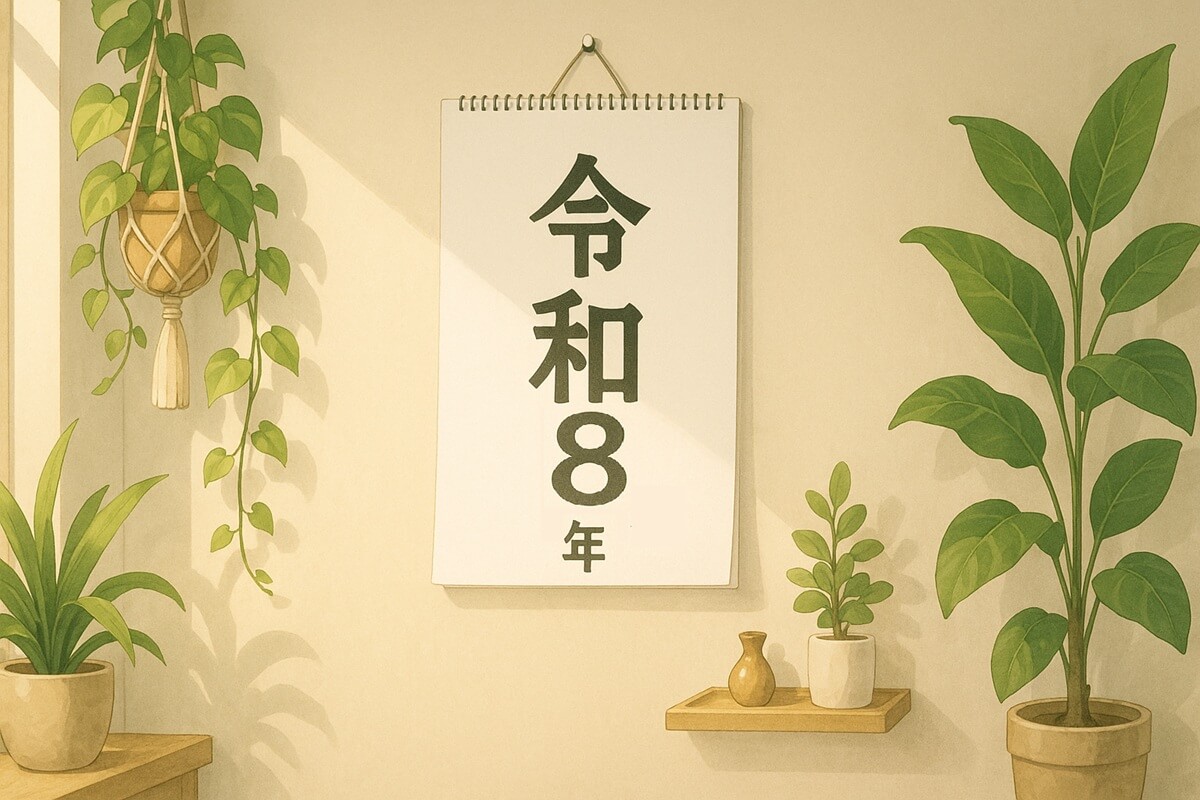
Happy New Year from Japan! The New Year is a good time to look at how Japan counts its years: not only by the Western calendar but also by a unique era name system called gengo (元号).
The Japanese mark time in a way that feels both ancient and current. Alongside the familiar Gregorian calendar, they use era names, or gengo (元号). Each era begins with a new emperor’s reign and has a name chosen to reflect hopes for the years ahead. If you’ve ever come across dates like Reiwa 6 (令和6年) or Heisei 28 (平成28年) and wondered what they mean, this guide will make it clear.
What Era Names Are
Era names are official designations for the period of an emperor’s reign. For example, instead of just saying 2026, people might say “Reiwa 8 (令和8年).” The name only changes when there is a new emperor. During an era, the name stays the same and only the year number increases.
How the Tradition Started
This system traces back to the year 645. Japan adopted the idea from China but quickly made it its own. In the earlier centuries, the era name changed more often, sometimes to mark major events or disasters.
By the late 1800s, the rule changed so that each emperor had only one era name, making the system more stable and easier to use.
Examples Through History
- Meiji (明治, 1868–1912): A period of rapid modernization.
- Taisho (大正, 1912–1926): A time of cultural expansion and political change.
- Showa (昭和, 1926–1989): An era that included war, hardship, and remarkable recovery.
- Heisei (平成, 1989–2019): Intended to express hopes for peace.
- Reiwa (令和, 2019– ): Began in 2019; its name, drawn from classical poetry, conveys harmony.
How Era Names Are Chosen
Today, the process is formal and deliberate. A panel of scholars and officials reviews potential names, each taken from classical Chinese and Japanese texts.
The chosen name must:
- be easy to read,
- look good when written,
- and avoid negative connotations.
The prime minister publicly announces the final choice. Within hours of the announcement, the era name starts appearing everywhere—government forms, news broadcasts, and public signage.
How Era Names Are Used
Era names are used widely throughout Japan, including:
- government forms that request birth dates in gengo (元号) format,
- official identification such as driver’s licenses and tax documents,
- calendars that list both Gregorian years and era years.
In everyday conversation, people also use era years naturally. For example:
- “I was born in Showa 63 (昭和63年).”
- “This model was released in Heisei 20 (平成20年).”
How to Convert an Era Year
To convert an era year to a Gregorian year:
- Take the first year of the era.
- Subtract 1.
- Add the era year you’re converting.
Example: Reiwa (令和) began in 2019.
Reiwa 6 (令和6年) = 2019 − 1 + 6 = 2024.
Why Era Names Still Matter
Japan does not see technology and tradition as opposites. Era names (元号) remain an important cultural element, marking the beginning of new national chapters. You’ll find them in personal identification, media, government planning, and even pop culture.
They give rhythm to history, helping people identify periods not just by numbers but by the eras that shaped them.
Final Thought
An era name is more than a label—it ties the present to more than a millennium of history. The next time you see a date like Reiwa 8 (令和8年), you’ll recognize it as both part of today and connected to a long historical legacy.